In the previous post, I mentioned how research into academic texts show that the majority of words in a text are words that are very common in ‘general’ English. This means that they are just as common in everyday conversation as they are in academic English, and they are not too specific to a particular subject, e.g. Law, Medicine, Engineering, etc.
While most learners preparing for the IELTS test will know a lot of these words already, there may be some that learners don’t already know. The research I mentioned in my previous post (see Coxhead, 2000) used a list of the most common 2,000 words in English, but this list is very old, so it’s probably worth using a more recent list. However, most of the recent word lists for ‘general’ vocabulary seem to cover roughly the most common 3,000 words in English, but it’s probably worthwhile learning these extra 1,000 words (and more) if your aim is to study in English at university in the future as learning 2,000 ‘general’ words + 570 ‘academic’ words (from the Academic Word List) would still mean that you only know around 85% of words in an academic text, which isn’t enough to get a good understand of a text. (Incidentally, research suggests that the percentage of words needed to have a good understanding of a written text is probably at least 95% and more likely closer to 98%.)
In the previous post, I mentioned how the Longman Dictionary can help you to identify academic words, and it can also be used to help identify common ‘general’ vocabulary. For example, if we search for the word ‘unfortunately’, we can see three red circles followed by ‘S1’ and ‘W3’. This means that the word is one of the most common 1,000 words in spoken English (S1) and one of the 3,000 most common words in written English (W3). In other words, it is more common in spoken English than written English. Although it might not be on the Academic Word List, it is still important to know this word because it is common in both spoken and written English.
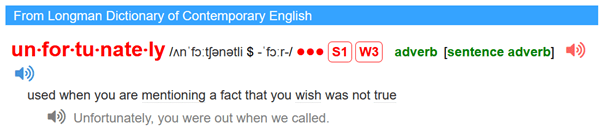
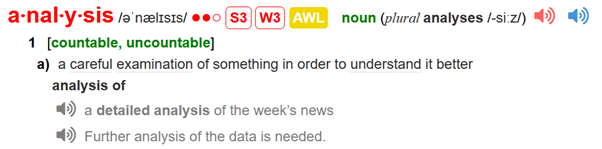
So, any word that we search for in the Longman dictionary that has three red circles next to it and/or either S or W with either a 1, 2 or 3 next to it is going to be a useful word to know and learn. Some of these words will also appear on the Academic Word List, but that’s OK, e.g. see below for ‘analysis’:
Oxford Dictionaries also gives information about the most important 3,000 words using a text checker(Oxford Text Checker) with its Oxford 3,000 word list. By copying and pasting a text into the text checker, it can highlight which words are the most important 3,000 words in English and at what level most learners know this word by using different colours, e.g. if we use the first paragraph of this blog post, then the Oxford Text Checker produces the following result:
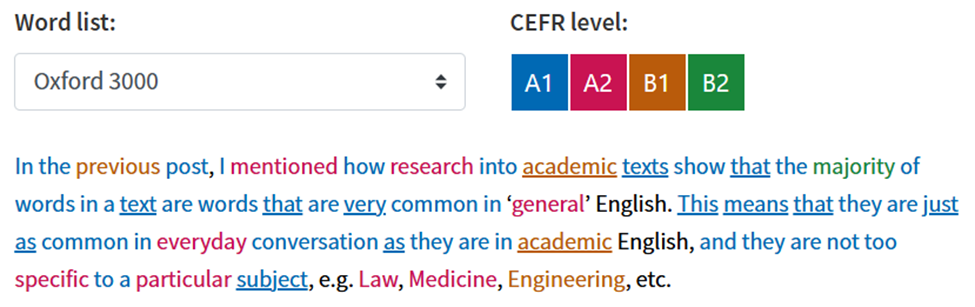
Any word in black is not part of the most important 3,000 words.
Similar to the colours in the text checker above, the Oxford Learner’s Dictionary also indicates the different levels at which a learner should know a word, e.g. for ‘unfortunately’, it indicates that A2 (pre-intermediate) level learners should know this word, as shown below:
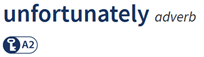
Similarly, for ‘analysis’, it is indicated that B1 (intermediate) level learners should know this word:
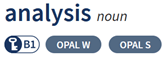
We can also see from ‘OPAL W’ and ‘OPAL S’ that this word is common on both written academic English and spoken academic English (OPAL = Oxford Phrasal Academic Lexicon).
So, these are a couple of useful ways in which dictionaries and text checkers can be useful to help you identify frequent ‘general’ vocabulary. In the next blog post, I will look at medium-frequency ‘general’ vocabulary, which will be especially useful for higher-level learners.
References
Coxhead, A. (2000). A new academic word list. TESOL quarterly, 34(2), 213-238.


Leave a reply to Useful Websites for Vocabulary Learning – Medium Frequency ‘General’ Vocabulary – Self-Study English Cancel reply