Five British TV Dramas to Watch on Netflix (and practise your English!)

As Lunar New Year approaches, for some, it might be the perfect time for a bit of binge watching of Netflix. Therefore, I thought now might be a good time to share some of my thoughts on British TV dramas available that I’ve watched on Netflix. Although I’ve seen each episode of every series for all of these dramas, it was a while ago that I watched some of these, so forgive me if my memory is a little hazy! I’ve ranked them in order from my least to most favourite (though I enjoyed them all).

5. Heartstopper

Starting off on an upbeat note, Heartstopper is an adaptation of a teen graphic novel of the same name. Whilst it centres on the development of the relationship between Charlie and Nick, it also includes a variety of LGBT themes such as the inclusion of Elle, a trans girl, who has recently transferred from a boys school to a girls school. However, unlike many LGBT dramas, which often involve tragedy, this frames the lives of young LGBT people in a much more positive way. This doesn’t mean that issues such as homophobia and transphobia are not touched upon, but such themes are not necessarily central to the character’s storylines. Whether Heartstopper accurately represents what it is like to be LGBT in British schools today is hard to say. I certainly hope so, and it would help to show how far society has developed since I was at school in the 1990s. Back then, I knew of no openly LGBT students in my school, and the thought of anyone finding out about my sexuality at school terrified me beyond belief. For this positive portrayal alone, notwithstanding some clunky screenwriting and being a little twee at times, Heartstopper is definitely worth a watch. Especially so if you’re looking for a sweet and uplifting romance that showcases LGBT lives in a fun and joyful manner. 

4. The End of the F***ing World

This is pretty dark right from the beginning when we learn about 17-year-old James’ sadistic childhood hobby of torturing and killing animals. Not content with animals, he decides he wants to take his sadistic fantasies to the next level. This is where he meets Alyssa at school, a troubled girl of the same age who sees in James a like-minded soul who doesn’t quite fit in with the rest of the world. With both of them seeing an opportunity (though they have different ideas in mind), they steal James’ dad’s car and embark on a journey that starts off in fairly gruesome style and doesn’t get much better after that. However, as well as all the violence, there are also some sad, some funny and occasional uplifting moments along the way. Even amongst the litany of despotic crimes committed, there are still parts of James and Alyssa’s character that one can find room to empathise with, even if it takes a little searching for. Overall, it’s definitely not one for the faint-hearted, as it looks into the darkest recesses of the human soul and what it finds is not always particularly pretty.

3. Black Mirror

If you wanted something a little more cheery, Black Mirror probably isn’t the programme for you. Mixing the twin themes of technology and a dystopian future, the show has often been disturbingly prescient of real-life events, even if it wasn’t intentional. Though some of the imaginary futures depicted are obviously a little far-fetched, the series provides a useful social commentary on the dangers of humanity relying too much on the possibilities afforded by the uncritical adoption of technology. That said, not every episode offers a glimpse into the possible malfunction of society. For instance, my favourite episode is the enchanting ‘San Junipero’ from season three, which offers a thoughtful perspective on life and death, amid a whirlwind of nostalgia and romance. With six series made in total (and at least one more in the pipeline), it is possible that Black Mirror has lost some of the innovativeness of the earlier series as the shock-factor has certainly begun to wane. In spite of its gradual decline, few other TV dramas pack as much punch while offering a window to the potential alarming (and often real) uses of technology in modern society.

2. Afterlife

Although the creator of Afterlife (Ricky Gervais) is better known for his comedic work, Afterlife is more likely to have you break into tears rather than into laughter. After all, what could be sadder than losing the person who means everything in the world to you? That is what happened to Tony (played by Ricky Gervais) and Afterlife tells the story of how Tony coped in such difficult circumstances. In the beginning, the answer was not very well, as Tony lost all purpose in life and took out his revenge on those around him for the tragedy of losing his partner, Lisa. However, with the help of a chance encounter whilst visiting Lisa’s grave, he slowly starts to make sense of Lisa’s death and how to move forward with his life. There are scenes of unbearable sadness during Afterlife, but also funny, touching and uplifting moments too. And most of all, there is hope. There is hope that no matter what life throws at you, there is always a path forward, even if it can be difficult to find it at first.  

1. Sex Education

When I first heard about Sex Education, I assumed that it would be a show with lots of terrible jokes about sex and very little depth. How wrong could I be? Actually, there are some funny scenes related to sex, many of which centre around the awkwardness of Otis, such as some toe-curling conversations his sex therapist mother tries to initiate with him. Surprisingly though, in spite of his lack of experience and awkwardness around many issues related to sex, Otis follows in his mother’s footsteps and starts his own sex therapy business at his high school; hence, the title of the show ‘Sex Education’. However, it would be a mistake to think that a) the show is primarily about sex, and b) that Otis is the star of the show. Firstly, the show is really about relationships and not just of the romantic variety. For example, the relationship that Otis has with his Mum, best friend (Eric) and his on-off girlfriend (Maeve) all have numerous ups and downs throughout the course of the show.

More important though, are the relationships that the characters have with themselves. As an example, both Eric and Maeve go on remarkable journeys in the course of the show’s four seasons that leave you in awe of their strength and resoluteness. However, my favourite character is undoubtedly Aimee. On first appearance, she might not seem the most intelligent character, but in the face of adversity, she shows herself to be fierce, determined and funny, but above all kindhearted and a really good friend when she is needed most. In fact, Aimee is one of many characters on the show who prove the old adage ‘don’t judge a book by its cover’. There are a few examples of characters (such as headteachers) who at first sight seem to be rather unpleasant characters. But once a few layers have been stripped back, they show themselves also to be quite troubled and vulnerable creatures in some way, making it hard not to feel empathy with even some of the seemingly least likeable characters on the show. And if there is one overriding strength of the show, it is the characters and the depth that many of them show. Therefore, if there is one legitimate criticism that is to be leveled at Sex Education, it is that it brings in too many new characters in the final season. Whilst each one has an interesting backstory, there isn’t enough time to do justice to their individual and competing storylines. That said, this doesn’t take away from my overall enjoyment of the show, which had me frequently both laughing and sobbing uncontrollably, and sometimes even at the same time!

How to Use Sample IELTS Writing Answers

I have already shown how you can use IELTS reading and listening texts to help you develop your language skills to help you prepare for the IELTS test, and in this blog post, I will show you how you can use sample writing answers to help you prepare for the IELTS writing test.

First of all, before reading a sample answer, it would obviously be beneficial to think a little about the question or task. Even if you don’t want to write an answer yourself first, you can still take some time to think about the question and what you would include in your answer. For part 1, this might include:

  • thinking about how to change the language in the question to write the first sentence
  • identifying the main features and thinking about what information to include in an overview
  • thinking about what specific details you would include and what data to describe
  • thinking about how you would organise these specific details into two or three paragraphs
  • thinking about what language you could use to describe the data, map changes, process, etc.

For part 2, this might include:

  • understanding what you need to do to answer the question
  • thinking about your opinion on the topic
  • thinking about what ideas you could include and how to develop these ideas
  • thinking about how to organise these ideas into paragraphs
  • thinking about what language you could use to show your opinion and link ideas together

Once you have done these, you can then read a sample answer and compare against your own ideas and make a note of any differences. For part 1 answers, probably the most useful thing you can do is focus on what information is included in the overview, identify what data has been reported and identify any language that has been used to describe the data, map changes or stages in a process.

For part 2, the most useful thing to do probably involves identifying the overall opinion, the organisation of the main body, how ideas have been developed with reasons and examples in each paragraph and any language that has been used to show opinion and link ideas together.

However, when using sample answers, you need to make sure that you are using reliable answers as there is a lot of material available that is of questionable quality. Here are some websites that I think have quite reliable samples answers that you can be helpful for you:

Part 1 Sample Answers

IELTS Buddy (Part 1)

English Exam (Part 1)

IELTS Focus (Part 1)

Part 2 Sample Answers

IELTS Buddy (Part 2)

English Exam (Part 2)

IELTS Focus (Part 2)

How to Use IELTS Listening Texts

In the previous post, I showed you a procedure for using the reading texts. Here, I will show you a similar procedure for using the IELTS listening texts for both practice and developing your language skills.

The main difference between difference between the reading and listening tests is that when listening, you only have the opportunity to listen once. However, obviously when preparing for the exam, you can listen as many times as you want, so it makes sense to use this opportunity in order to increase understanding.

Before starting to listen to the recording, you will be given some time to look at the questions. It is very important that you use this time carefully in order to help better understand when you are listening. Depending on the type of questions you need to answer, doing some of the following will be useful:

  • using any headings (if there are any) to predict the topic of the listening
  • reading and highlighting/underlining key words in the questions
  • predicting what kind of information will go in the gap

After listening once and entering your answers, it is a good idea to listen again as you likely missed some answers or were unsure about some answers. You may want to write your answers after listening the second time in a different coloured pen, so you can see which answers you got correct on the first time of listening. If you find the text very difficult, you may want to listen a third or even fourth time. Regardless of how many times you listen before checking your answers, I would always recommend listening again to just focus on the main ideas in the text. This will help you have a better understanding of the whole text, and as with reading, better understanding of the text, leads to more processing of language, and therefore more language learning takes place. Depending on the type of listening, you may also want to ask yourself some of the questions suggested for reading texts.

You may also want to listen again to help you understand why you got any answers wrong. Alternatively, you could use the transcript (the text of the listening) to help you understand why you got any answers wrong.

As with reading texts, you may also want to look for new vocabulary (both general and academic) that could be useful in the future, though you are likely to find less new vocabulary in listening transcripts compared to reading texts.

How to Use IELTS Reading Texts

When doing practice IELTS reading tests, it’s important that you do not just to use them as test practice, but also to use them to help develop your language skills. Here is a suggested procedure for how you can use IELTS reading tests to help you both practice the test and also develop your language skills at the same time.

First of all, I would suggest that you get a general idea of what the text is about before looking at the questions. If you are a fast reader, you may decide to quickly read the whole text first before looking at the questions, but for most students, I think this will take too much time.

To get a general idea of a text, I would suggest looking at the following parts of a text:

  • Title of the text (most important part)
  • The first paragraph (this is likely to include some kind of general introduction to the topic, and will therefore help to give a general idea of the text)
  • The first sentence of each paragraph (these are often similar to topic sentences that you use in your writing, and often give a general idea/summary of what the paragraph will be about)
  • The final paragraph (these often contain some kind of conclusion or summary, which includes more general ideas than much of the rest of the text)

By reading these parts of the text, you should be able to get a general idea of what the whole text is about. This will give you a better understanding of the text, and therefore should help you when answering questions about specific parts of the text.

Once you have completed the IELTS answers, I would suggest that you read through the whole text again, and try to summarise to yourself (you can make notes if you wish) what the main ideas of the text were. You may also want to ask questions to yourself about the text such as:

  • What did I learn from reading this text?
  • Is there anything from the text that was surprising? If so, why?
  • Which parts of the text did I most agree with? If so, why?
  • Is there anything that I disagree with? If so, why?
  • Are there any parts that I didn’t understand? If so, what made them difficult?

Asking yourself these kinds of questions can help you think about the text more deeply and therefore be more likely to better understand the text. This means that you will then thus process some of the language better and improve your language skills more.

After doing this, you can then focus on some individual words and phrases that you have found in the text, which may be new to you. However, you do not necessarily want to try and learn every new word you see in a text as there will likely be quite a few words that are not very common, and so will not be very useful for you to learn. Instead, it is better to focus on those words which are more common, and so more useful.

There are two types of vocabulary that students should focus on. The first type is frequent general vocabulary as these make up most words in a text. You can find out how to use a dictionary and other resources to help identify these words in this blog post. More advanced learners may also like to also focus on mid-frequency vocabulary too (see this blog post).

The second type of vocabulary to focus on is academic words. These words are especially important for the IELTS exam (and when studying at university). You can use this blog post to learn more about academic words and help you identify academic words from a text.

IELTS – The Paper Based Test (PBT) vs the Computer Based Test (CBT)

One factor that you need to consider when doing the IELTS test is whether to do the paper-based text (PBT) or the computer-based test (CBT). Although both tests are the same (i.e. same questions in the reading, listening and writing) test, there are number of reasons why you might prefer to do one over the other.

For me, probably the biggest consideration is time. Firstly, if you are in a rush to get your results back, then doing the CBT test would be better as you get your results back in 3-5 days versus up to 14 days for the PBT. However, perhaps a more important factor related to time is how long it will take you to read and write in a CBT versus the PBT, especially given how much time pressure you are likely to experience during the IELTS exam.

Obviously, there is no simple answer to this as the time it takes will depend on each individual, but it has generally been accepted that reading on paper is faster than reading on a screen (Thompson, 2019). However, this may be changing due to better screen quality and people being more used to reading on screens nowadays. Perhaps more importantly though, especially when doing tests like the IELTS, is that it seems reading on paper leads to better understanding of a text compared to reading on a screen (Barshay, 2019). Therefore, although it may not be 100% clear, it seems that reading on paper might offer an advantage over reading on a screen.

However, when it comes to writing, the opposite is likely to be true. For most people, typing will be faster than writing by hand, but this again depends on a number of factors. For example, if you are more used to writing by hand than typing in your second language, then there might not be such a big difference in speed. Also, there are other factors that might come into consideration, such as the number of typos (which will take more time to check and correct), being able to edit more easily on a computer as well as the words being counted automatically for you. Again, there is no easy answer, but it seems like the CBT may be better for most people when it comes to the writing test.

In the end, the only way to really know which test is better for you is to try both of them, maybe time yourself and see which one you feel more comfortable with. Both test providers (IDP and British Council) offer a practice online test, so it’s worth trying the online test a couple of times before deciding whether to do the CBT or the PBT.

For more information about the CBT, you can view these helpful YouTube videos:

There is also a useful summary of advantages and disadvantages of both the PBT and the CBT in the following article:

https://ieltsliz.com/computer-delivered-ielts-pros-cons/

References:

Barshay, J., 2019. Evidence increases for reading on paper instead of screens. [online] The Hechinger Report. Available at: <https://hechingerreport.org/evidence-increases-for-reading-on-paper-instead-of-screens/&gt; [Accessed 11 October 2021].

Thompson, A., 2019. Study: Paper Reading More Effective Than Screen Reading. [online] VOA. Available at: <https://learningenglish.voanews.com/a/study-paper-reading-more-effective-than-screen-reading/4876473.html&gt; [Accessed 11 October 2021].

Extensive Reading Recommendations

As I have shown in a previous blog post, doing extensive reading with graded readers is one of the most useful things you can do to improve your English. However, sometimes it can be difficult to know what book to choose that will be interesting. Since I mostly read non-fiction books for pleasure, I am not sure that I am very good at recommending what books to read, especially as each person will have different interests. Despite that, I have managed to produce a list of books that might be a useful starting point for learners who have difficulty in choosing what to read. By using a list of the finalists and winners (winners have a * next to their title) from the Extensive Reading Language Learner Literature Award, I have created a list of recommendations.

Please note, that I have only included books that are available to read online from the English e-Reader website. You can access an online text of the book by clicking the name of the book title. If you want more information, you can click the name of the publisher, which will take you to their page. I am not sure about the accuracy of the information on the English e-Reader website, so the information about pages and level has been taken from the publisher, rather than the website English e-Reader website. For some classic books, there has been more than one book written by different publishesr, so I am not always 100% sure which version has been used. I have indicated this with a question mark (?) next to the publisher name.

For the final two columns of the table below, CEFR level = Common European Framework of Reference for Languages level, where B1 = intermediate, B2 = upper-intermediate and C1 = advanced. ERF level = Extensive Reading Foundation level. You can find your level by going to the Extensive Reading Central website and following the instructions after clicking ‘Check my Level’.

https://www.er-central.com/student-registration/
BOOK TITLE (Publisher)PUBLISHERGENRETYPEPAGES ERF LEVELaCEFR LEVELb
The Everest StoryOxfordNon-Fiction Modern808A2/B1
Rabbit-Proof FenceOxfordNon-FictionModern808A2/B1
The No.1 Ladies Detective AgencyPearsonDetectiveModern569A2/B1
A Kiss Before DyingMacmillanMysteryModern9611B1
Body on the RocksHueberMysterlyModern8411B1
Not Without YouOxfordSci-FiModern7211B1
The Accidental TouristOxfordMysteryModern11211B1
RebeccaMacmillan?GothicClassic14413B2
Barchester TowersOxfordComedyClassic12814B2/C1
Captain Corelli’s MandolinPearsonRomanceModern12014B2/C1
Cry FreedomOxfordNon-FictionModern12814B2/C1
The Best of Times?*CambridgeRomanceModern11215C1

a* ERF = Extensive Reading Foundation
b* CEFR = Common European Framework of Reference for Languages

Useful Websites for Vocabulary Learning – Medium Frequency ‘General’ Vocabulary

In the last blog post, I explained how you could use dictionaries and text checkers to identify useful vocabulary to learn and remember. In that post, I focused on the 3,000 most frequent words in English. However, to get to higher levels of English, achieve a high score on the IELTS and to be able to read academic texts at university, you will need to know a lot more than 3,000 words.

According to Nation (2006), you need to have a vocabulary of about 6,000 to 7,000 words in order to have a good understanding (98% of all words) of a spoken text such as a movie, whereas for written texts such as novels and newspapers, this increases to about 8,000 to 9,000 words.

Before deciding on what words to focus on, it might also be useful for you to do a vocabulary size test. You can do one at this website and it should take less than one hour to complete.

You might also be interested to know how many words you need to know to be at each level of English. Now, this is a difficult question to answer as it depends on how you measure when a learner knows a word. For example, there will be a big difference between receptive vocabulary (what you can understand, i.e. in reading and listening) and productive vocabulary (what you can use, i.e. in speaking and writing).

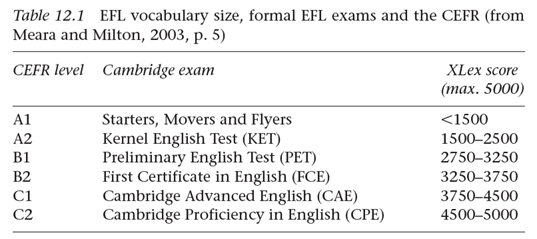
 The only research paper I could find gave the following estimates for vocabulary sizes:

Taken from: Milton, J., & Alexiou, T. (2009). Vocabulary size and the common European framework of reference for languages. In Vocabulary studies in first and second language acquisition (pp. 194-211). Palgrave Macmillan, London.

However, I am a little unsure of these numbers, especially at the higher levels as most C1 level learners could probably understand most words in a film and even in novels that are not too difficult. Therefore, I would expect the vocabulary level to be higher at both C1 and C2 level, especially as very few learners ever achieve a C2 level of English.

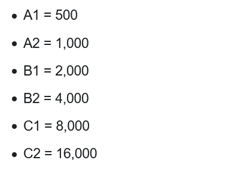
Although this is not an academic source, so perhaps less reliable, I found the following discussion online and I feel that some of the estimates here to be more realistic, e.g.

This estimate suggests that the number of words required doubles to reach the next level rather than increasing by about 500 words for each level. Although this is not based on any research evidence, the above estimates do seem to be more likely than the previous estimates, especially for the higher levels.

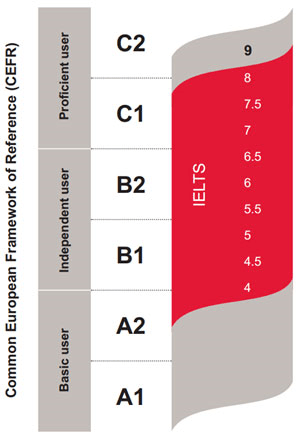
As a useful reference, the image below shows roughly how the different CEFR levels (A1-C2) relate to the IELTS exam. Whichever scale from above you use, it is clear that you are going to need over 3,000 words to achieve a score of 6.5 or higher on the IELTS test.

In the previous post, I mentioned the Oxford 3000 list. There is also an Oxford 5000 word list, so if you think you know most of the words at the 3,000 word level, then it would be worth focusing on the additional 2,000 word on the Oxford 5000 list.

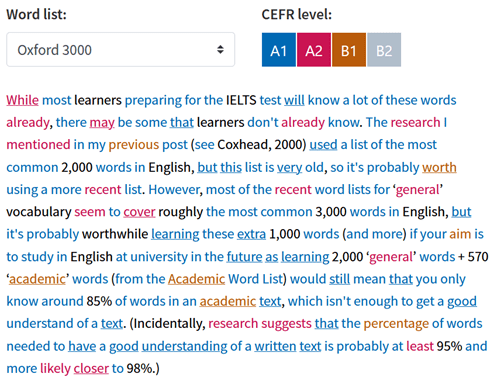
As with the Oxford 3000, we can also use a text checker to find out what words are on the Oxford 5000 list by copying and pasting a text into the box, e.g. below shows the results (up to B1 level) for the Oxford 3000 list.

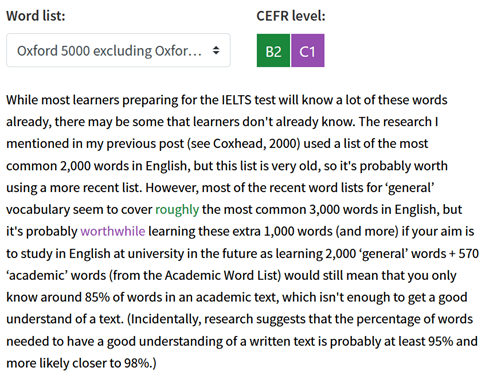
And below shows the results for the Oxford 5000 list (B2 and C1 level), not including all the words at in the Oxford 3000 list.

Another dictionary that I didn’t mention in my previous blog post is the Macmillan Dictionary. This dictionary uses a system of red stars to indicate frequency. To summarise:

  • 3 stars = 0-2,500 most common words
  • 2 star = 2,500-5,000 most common words
  • 1 star = 5,000-7,500 most common words

For example, by searching for the word ‘analysis’, we can see that it is one of the most common 2,500 words in English as it has three stars next to it:

If we search for the word ‘magnificent’, we can see that it is slightly less common, but still one of the most common 5,000 words in English as it has two stars next to it:

The following YouTube video gives a very clear and easy to understand overview of the red star system for Macmillan dictionary:

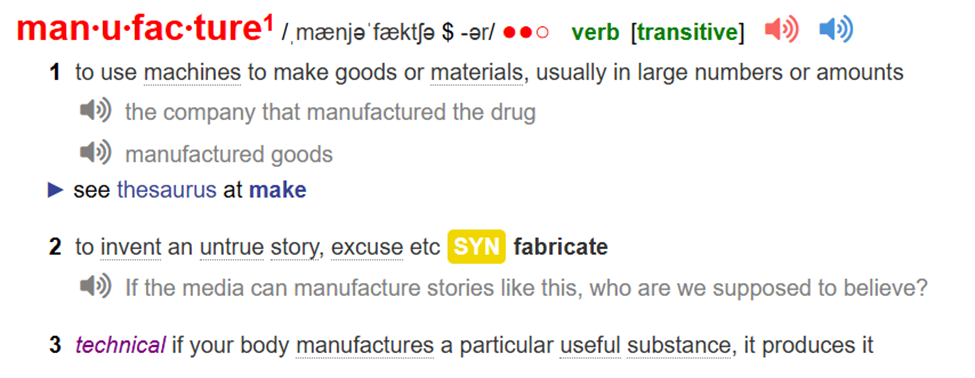
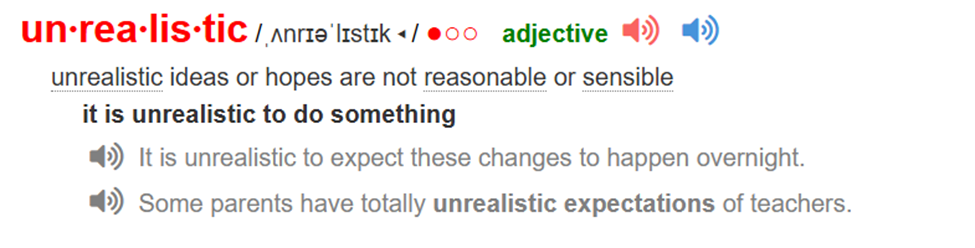
If you want to expand your vocabulary learning a bit further, you can use the Longman dictionary to help you find slightly less common words than in the Macmillan dictionary.

As mentioned previously, the Longman dictionary has red circles next to each word to indicate frequency. Here:

  • 3 circles = 0-3,000 most common words (High frequency)
  • 2 star = 3,000-6,000 most common words (Medium frequency)
  • 1 star = 6,000-9,000 most common words (Lower frequency)

As with the Oxford dictionary, there is a vocabulary checker tool, which can highlight words at different levels as well as words from the AWL (Academic Word List), e.g.

However, vocabulary lists are probably more useful when they are either for higher frequency words (as the lists are more likely to be accurate) and for specific vocabulary. Therefore, you should be careful about using these lists as the reliability of these lists depends on the kind of texts that have been used to create a database of language. Whilst I would assume that these dictionaries have quite reliable databases, there will be some differences, especially for lower frequency vocabulary as they won’t have used exactly the same texts.

It is also worth mentioning that this kind of self-study activity should only be one part of your vocabulary learning. An even bigger part of your vocabulary learning should be through getting lots of input as I have shown in previous blog posts (see here and here).

In the next few blog posts, I will focus more on strategies that can help you remember vocabulary.

References:

Milton, J., & Alexiou, T. (2009). Vocabulary size and the common European framework of reference for languages. In Vocabulary studies in first and second language acquisition (pp. 194-211). Palgrave Macmillan, London.

Nation, I.S.P. (2006). How large a vocabulary is needed for reading and listening? Canadian Modern Language Review, 63(1), 59-82.

Useful Websites for Vocabulary Learning – Frequent ‘General’ Vocabulary

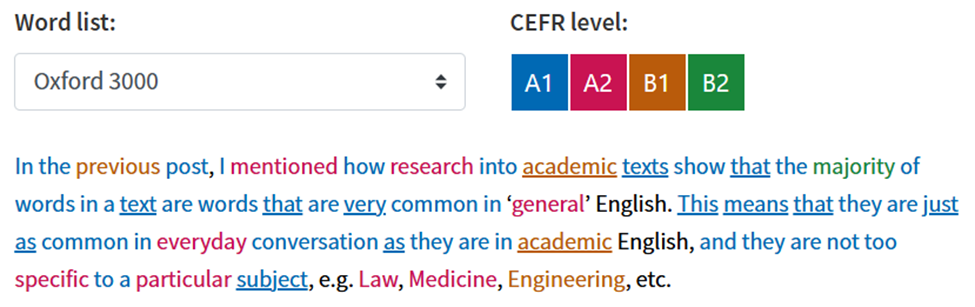
In the previous post, I mentioned how research into academic texts show that the majority of words in a text are words that are very common in ‘general’ English. This means that they are just as common in everyday conversation as they are in academic English, and they are not too specific to a particular subject, e.g. Law, Medicine, Engineering, etc.

While most learners preparing for the IELTS test will know a lot of these words already, there may be some that learners don’t already know. The research I mentioned in my previous post (see Coxhead, 2000) used a list of the most common 2,000 words in English, but this list is very old, so it’s probably worth using a more recent list. However, most of the recent word lists for ‘general’ vocabulary seem to cover roughly the most common 3,000 words in English, but it’s probably worthwhile learning these extra 1,000 words (and more) if your aim is to study in English at university in the future as learning 2,000 ‘general’ words + 570 ‘academic’ words (from the Academic Word List) would still mean that you only know around 85% of words in an academic text, which isn’t enough to get a good understand of a text. (Incidentally, research suggests that the percentage of words needed to have a good understanding of a written text is probably at least 95% and more likely closer to 98%.)

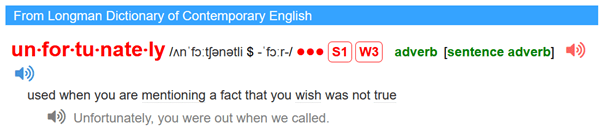
In the previous post, I mentioned how the Longman Dictionary can help you to identify academic words, and it can also be used to help identify common ‘general’ vocabulary. For example, if we search for the word ‘unfortunately’, we can see three red circles followed by ‘S1’ and ‘W3’. This means that the word is one of the most common 1,000 words in spoken English (S1) and one of the 3,000 most common words in written English (W3). In other words, it is more common in spoken English than written English. Although it might not be on the Academic Word List, it is still important to know this word because it is common in both spoken and written English.

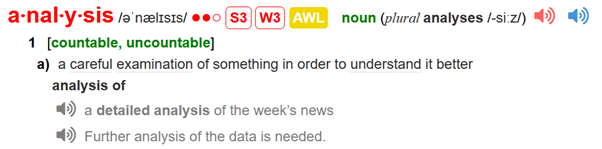
So, any word that we search for in the Longman dictionary that has three red circles next to it and/or either S or W with either a 1, 2 or 3 next to it is going to be a useful word to know and learn. Some of these words will also appear on the Academic Word List, but that’s OK, e.g. see below for ‘analysis’:

Taken from: https://www.ldoceonline.com/dictionary/analysis

Similar to the AWL highlighter, you can also copy and paste a text into the Longman Vocabulary Checker to find out what words are most common and which words are less common. It also includes a function to check for words from the Academic Word List too. Below is an example by using the second paragraph of this blog post:

After selecting the appropriate option and clicking ‘Check text’, we can see the most common words are highlighted in the box below.

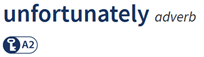
Oxford Dictionaries has a similar feature (Oxford Text Checker) with its Oxford 3,000 word list. The Oxford Learner’s Dictionary also indicates the different levels at which a learner should know a word, e.g. for ‘unfortunately’, it indicates that A2 (pre-intermediate) level learners should know this word, as shown below:

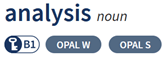
Similarly, for ‘analysis’, it is indicated that B1 (intermediate) level learners should know this word:

We can also see from ‘OPAL W’ and ‘OPAL S’ that this word is common on both written academic English and spoken academic English (OPAL = Oxford Phrasal Academic Lexicon).

So, these are a couple of useful ways in which dictionaries and text checkers can be useful to help you identify frequent ‘general’ vocabulary. In the next blog post, I will look at medium-frequency ‘general’ vocabulary, which will be especially useful for higher-level learners.

References

Coxhead, A. (2000). A new academic word list. TESOL quarterly, 34(2), 213-238.

Useful Websites for Vocabulary Learning – Academic Vocabulary

In previous posts, I have explained the importance of developing implicit language knowledge in order to become fluent in English at a high level. We can do this mostly by getting the right kind of input (see here, here and here). By doing lots of reading and listening we are learning vocabulary incidentally (implicitly). In other words, we are developing our implicit vocabulary knowledge by reading and listening for meaning rather than through any deliberate focus on learning vocabulary. This type of learning is obviously very important, but it can also be supported through learning vocabulary deliberately (explicitly). Here, we are developing explicit vocabulary knowledge, but doing this can also help to develop our implicit vocabulary knowledge. It does this because it: a) helps to give us more repetitions, so that we learn faster, and b) helps us to be able to read and listen to more difficult texts, therefore allowing us to get more input, which we know helps develop our implicit vocabulary knowledge.

Remember though that implicit language knowledge is really important for developing fluency in a foreign language, so it is important that deliberate vocabulary learning is used in addition to getting lots of input, and not a replacement for it. In my opinion, you should still spend considerably more time on getting input through reading and listening compared to deliberate vocabulary learning.

However, when doing deliberate vocabulary learning, it is very important that it is targeted, so that the most useful kind of vocabulary is learnt. Obviously, for students who are preparing for the IELTS test, vocabulary that is frequent in the texts for the reading and listening components will be useful as well as vocabulary that can be used in the speaking and writing components.

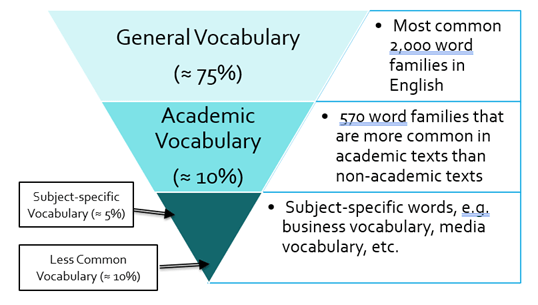
One way we can help to focus our vocabulary learning is by thinking about the type of vocabulary that is likely to be seen in reading and listening texts as well as be useful to use in the writing and speaking components. One way of doing this is by looking at some research (see Coxhead, 2000) into academic texts. This research showed that these texts generally had the following profile:

This diagram helps to show that we need to focus on the most common general words in English as these account for around three-quarters of all words in an academic text. However, these 2,000 words that are referred to above are taken from a word list that was created nearly seventy years ago (see West, 1953), so it might be a good idea to find a more up-to-date list of words to focus on.

Furthermore, most learners who are preparing for IELTS will already know most of these 2,000 words, so I am going to focus on learning ‘academic’ words in this post. The previously mentioned research (see Coxhead, 2000) analysed lots of different academic texts across lots of different academic subject areas (e.g. Medicine, Law, Economics, English Literature, Chemistry, History, etc.). This analysis was used to create a list of words that are common in all different academic subject areas. The result was the creation of the Academic Word List (AWL), which is a list of 570 word families (e.g. analyst, analyse, analysis, analytic, etc. all count as one word family). You can find a list of these word families here: https://www.eapfoundation.com/vocab/academic/awllists/

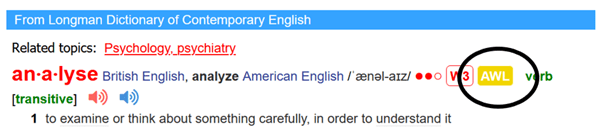
Some of these words, you will already know and some of them will be new to you. Apart from looking at the list above, there are a couple of ways that we can check whether a word appears on the Academic Word List (AWL). The first way is by checking in the Longman dictionary. When we search for a word in this dictionary, it will tell us if a word appears on the Academic Word List by indicating ‘AWL’ in a yellow box. If we can see this yellow ‘AWL’ box, this indicates that the word appears on the Academic Word List, and is therefore quite a useful word to learn, e.g. see below for ‘analyse’:

Taken from the Longman Dictionary of Contemporary English (https://www.ldoceonline.com/)

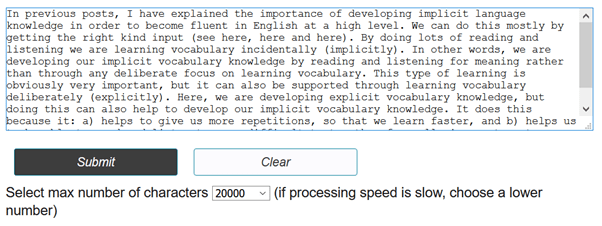
This is probably the best way to check any new words that you might see in your textbook or any texts printed on paper or in a book. However, if you are reading an online text, it can be better to use the AWL highlighter, which will highlight any words from the AWL when you copy the text into the box on the following page: https://www.eapfoundation.com/vocab/academic/highlighter/

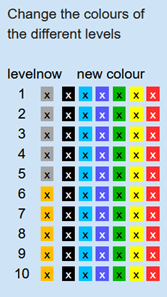
Using the first paragraph from this blog post as an example, you can see below that several words have been highlighted. You will notice that some are coloured grey and some are coloured orange:

Taken from: https://www.eapfoundation.com/vocab/academic/highlighter/

If you look on the sidebar on the left, you can see that these colours relate to different ‘levels’. These levels (1-10) are organised by frequency. In other words, level 1 has the most frequent academic words and level 10 has the least frequent academic words.

Now obviously, it would be nice to know all of these words on the Academic Word List, but there are a lot to learn, so that could be quite a big task. It is therefore better to focus your vocabulary learning on the most useful words from the list, i.e. levels 1, 2, 3, etc. rather than say levels 9 and 10. However, where you start learning on the list will depend on how many words you already know from the list (most learners will probably already know quite a lot of words from level 1).

When using this tool, you can change the colours for each level to help you identify the words from the levels that you want to focus on.

Before finishing, I should mention that the Academic Word List is not the only list of academic words, but it is probably the most well-known. If you are interested in other lists of academic words, you might want to read this journal article (Therova, 2020). One of the lists mentioned in the article is from Oxford Dictionaries called the Oxford Phrasal Academic Lexicon (OPAL), which has more words than the Academic Word List and also divides words into spoken and written academic words. It also has different sublists, thus allowing you to target your vocabulary learning.

In a later blog post, I will show you some apps that you can use to help you learn the words from the Academic Word List. However, in the next blog post, I will show some tools that help to focus your vocabulary learning on ‘general’ vocabulary.

References

Coxhead, A. (2000). A New Academic Word List. TESOL quarterly, 34(2), pp213-238.

Therova, D. (2020). Review of Academic Word Lists. TESL-EJ, 24(1). Available at: https://www.tesl-ej.org/wordpress/issues/volume24/ej93/ej93a5/

West, M. (1953). A General Service List of English Words. London: Longman, Green and Co.

Should I apply for a remark of my IELTS test?

One conversation that I have had a few times recently is whether it is worth getting a remark (officially called Enquiry on Results) of your IELTS test if you feel that you got a lower score than you deserved.

First of all, I should say that I don’t have any specific knowledge about this issue. I am only using my own judgement along with publicly available information from IDP and the British Council. Mistakes do happen sometimes and so there might be some occasions where applying for a remark could be worthwhile.

However, there are also a few questions that are probably worth asking yourself before deciding whether to apply for a remark.

Can I afford it?

The cost for a remark is 4,100 NTD with the IDP and 4,000 NTD with the British Council. The price is the same regardless of whether you have one component marked or you have all four components remarked. If your mark increases in any one of the components that have been remarked, then you will receive your money back 😊.

Which part of the test do I feel I underachieved in?

For the reading and listening tests, there are correct and incorrect answers, so the chances of a mistake being made in the marking are much smaller than for the writing and speaking tests, where there is some degree of subjectivity in how the marking criteria is applied. Therefore, if you are surprised by a low score in reading or listening, then it is much less likely that your score would increase as a result of a recheck. However, if you were surprised by a low score in writing or speaking, then it might be worth applying for a remark.

How much does my score need to improve by in order to achieve my target score?

If you need to improve your score by 0.5 of a band in one component to achieve your target score, then you have a much greater chance of success. For example, let’s imagine you need 6.5 overall and when you did the test you got:

R:7 L:6.5 W:5.5 S:5.5 = Overall 6.0

*See here for how to calculate IELTS scores.

In this example, increasing your score by 0.5 in just one component would increase your overall score to 6.5, so in this case it might be worth applying for a remark, especially if you feel your performed much better than your score suggests in either writing or speaking.

However, if you need to achieve a score of 6.5 overall and a minimum of 6 in each component, then you would obviously need to increase your score by 0.5 in both writing and speaking. In this case, obviously the chance of your score increasing enough to achieve your target score are much smaller.

Likewise, if your score needs to improve by a whole band in one component, the chance of your score increasing by one band are much smaller than 0.5 of a band.

Was my score much lower than previous tests that I have done?

If you have done the IELTS test previously and got a higher score in one component the first time you did the test, then this could be a sign that there was some mistake the second time round. For example, imagine you need to achieve a score of 7 overall and a minimum score of 6.5 in each component and the first time you did the test, you got the following score:

R:7.5 L:8 W:6 S:7 = Overall 7

Imagine you did the test a second time, and got the following score:

R:7.5 L:8 W:6.5 S:6 = Overall 7.5

In this situation, your score in speaking has dropped by a whole band from the first test to the second test, which is quite unusual. This could suggest that there may have been a mistake in the marking of the speaking component in the second test and it might be worth applying for a remark, especially as your speaking score would only need to increase by 0.5 of a band to achieve your target score. However, it’s also worth remembering that both speaking and writing both depend on your performance on the day of the test, so it is quite possible that a poorer performance in the second test will result in a slightly lower mark.

How long am I prepared to wait for the results of the remark?

According to the IDP website, ‘the process will take approximately 2 to 4 weeks.’ The British Council website states that The remarking process takes 2-4 working weeks after submission of the re-marked form, excluding time for posting to UK.’

Did I make any mistakes in the test?

It is important that you be honest with yourself here. The most serious mistakes that you could make are probably in the writing component, such as not properly answering the question in part 2 or not having time to finish your answer. If you feel that you may have made these kinds of mistakes, it might be better to accept your result and try again.

Conclusion

Before finishing this blog post, there are a couple of further points I would like to make. First of all, we are all human, and just like you or I, everyone makes mistakes sometimes, and that includes examiners. So, if you do get a lower score then you expected, try to spend a bit of time to calmly reflect on the situation instead of getting angry and telling all your friends how unfair the IELTS examiner was to you. If a mistake was made, it will be a genuine mistake and it does not mean that the examiner is a bad person!

The second point is that if you are thinking about applying for a recheck, it probably means that you only just missed out on getting your target score. In the best possible situation, applying for a recheck might mean that you get your target score. However, that would mean that you only just managed to achieve the target score. These target scores have been set by universities as the absolute minimum possible score in order to be successful in your studies. However, do you really want to pay all that money to study abroad on a course where you have only just met the minimum score? Maybe it would be better to spend a little more time studying and making sure that your language level is as high as it possibly can be, so that you have the best possible chance of success when you go on to study in English.

Ask other people who have studied in English abroad and they will most likely tell you how difficult it was, how much they had to read on their course or how much time they spent writing assignments, etc. Studying for IELTS is a piece of cake compared to studying in English at university, so be kind to yourself and give yourself the best possible chance of making it easier for yourself once you got there.

More Useful Links to Read:

https://ieltscharlie.com/ielts-remark/

https://www.ieltsadvantage.com/2016/03/29/should-i-get-my-ielts-test-remarked/

http://blog.myieltsclassroom.com/request-ielts-remark/

https://ieltsliz.com/ielts-remarking-success-story/