Many people know that doing lots of grammar exercises from a textbook is not very useful to help you become fluent in English. However, it can sometimes be difficult to explain why doing grammar exercises is not very useful. After all, we need grammar knowledge to help us communicate in English, so why is doing grammar exercises and learning grammar rules not very helpful?
First of all, I would like you to consider this question – how much knowledge of Chinese grammar did you have as a child before you started school? You have five options to choose from:
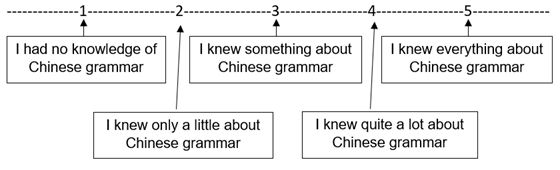
It is quite a difficult question to answer, so I will try to help answer it at the end of the post.
Secondly, I want you to think about this WhatsApp conversation I had with my two sisters a while ago. Both my sisters are educated native English speakers and I asked them the following question about English grammar:
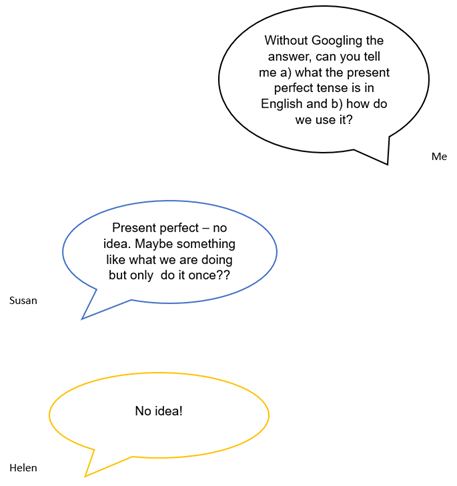
As you can see from the answers above, neither of my sisters have any idea what the present perfect is. Nor are they able to explain what it is or how to use it. However, they both speak excellent English and can use the present perfect tense in conversation without ever making any mistakes. So how is it possible that they can use the present perfect but cannot explain what it is?
The difference is because of different types of language knowledge.
Both of my sisters have very good implicit knowledge of the present perfect tense, but they do not have very good explicit knowledge of the present perfect tense.
Here is a summary of these two different types of language knowledge:
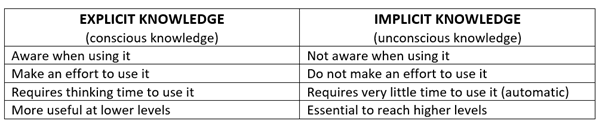
We use both types of language knowledge when communicating but implicit language knowledge is much more useful, especially when:
- we do not have time to think about our language use, i.e. speaking and listening
- we do not have any control over language use, i.e. reading and listening
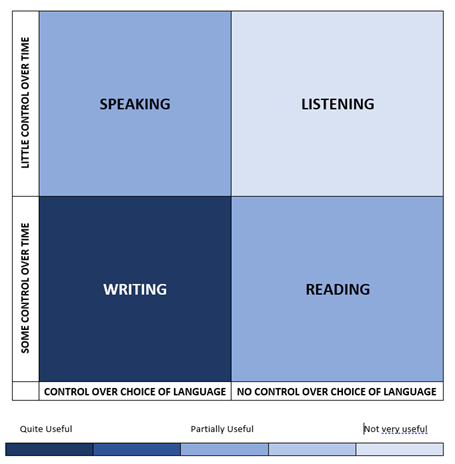
The diagrams below show my (unscientific) attempt to show how useful the different types of language knowledge can be.

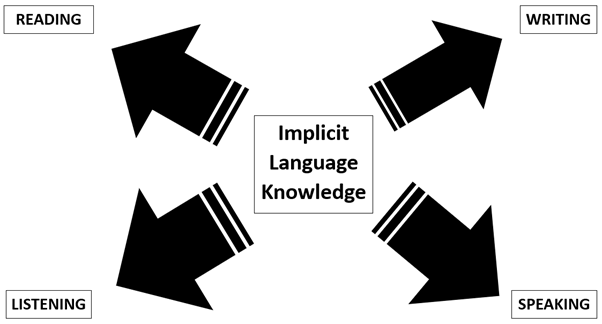
As you can see, the arrows in the diagram show that implicit language knowledge is more useful than explicit language knowledge for all four skills, especially listening. Explicit language knowledge is more useful for those skills when we have time to think and can control the language used, such as writing (time and control) and to a lesser extent, reading (time but no control). Explicit language knowledge can be useful at times when speaking (little time but some control) too but if you rely on it too much, then it will slow you down a lot and you will not be fluent. Explicit language knowledge is almost useless when listening as it is the only skill where you have little time and cannot control the language use. However, even though explicit language knowledge can be useful, to be successful in all skills (including reading and writing), you will need to mostly use implicit language knowledge.
In my opinion, explicit language knowledge about vocabulary is likely to be much more useful than explicit language knowledge about grammar. There are a few reasons why I think that:
- Vocabulary has a much more significant impact on making meaning clear in communication. You are much more likely to misunderstand when reading or listening or be misunderstood when speaking or writing due to problems with vocabulary knowledge compared to problems with grammar knowledge.
- Vocabulary is easier to remember and easier to apply in speaking and writing. A lot of grammar rules are quite complicated and abstract and so are difficult to apply when speaking or writing, whereas explicit vocabulary knowledge is easier to remember and apply.
- Focusing on developing explicit vocabulary knowledge will have more of an effect in helping you to understand more difficult texts. Explicit grammar knowledge will not help so much in improving your reading and listening level.
- Explicit grammar knowledge is not so useful in spoken communication. A lot of grammar in textbooks is based on written texts but the kind of grammar used in spoken communication is different to the grammar used in written communication. Therefore, the importance of ‘traditional grammar knowledge’ is less important in spoken texts. However, vocabulary knowledge is still very useful and necessary in both kinds of texts (spoken and written).
So, coming back to the original question at the beginning of the blog post about your knowledge of Chinese grammar when you started school, the answer depends on what kind of language knowledge is being referred to. As with my sisters, it is likely that you had a lot of implicit language knowledge of Chinese grammar but very little explicit language knowledge of Chinese. Today, you are likely to have much more explicit language knowledge of Chinese grammar but this knowledge is still tiny compared to the implicit language knowledge of Chinese grammar that allows you to communicate freely with very little effort. The aim in your English learning is to be able to get as close as possible to how you are able to communicate in Chinese. To do this, you should focus mainly on developing your implicit language knowledge of English. I will show you how you can do this in the next blog post.
References:
Ellis N.C. (2017) Implicit and Explicit Knowledge About Language. In: Cenoz J., Gorter D., May S. (eds) Language Awareness and Multilingualism. Encyclopedia of Language and Education (3rd ed.). Springer, Cham.


Leave a comment