Tag: listening

  • How to Use IELTS Listening Texts

    In the previous post, I showed you a procedure for using the reading texts. Here, I will show you a similar procedure for using the IELTS listening texts for both practice and developing your language skills.

    The main difference between difference between the reading and listening tests is that when listening, you only have the opportunity to listen once. However, obviously when preparing for the exam, you can listen as many times as you want, so it makes sense to use this opportunity in order to increase understanding.

    Before starting to listen to the recording, you will be given some time to look at the questions. It is very important that you use this time carefully in order to help better understand when you are listening. Depending on the type of questions you need to answer, doing some of the following will be useful:

    • using any headings (if there are any) to predict the topic of the listening
    • reading and highlighting/underlining key words in the questions
    • predicting what kind of information will go in the gap

    After listening once and entering your answers, it is a good idea to listen again as you likely missed some answers or were unsure about some answers. You may want to write your answers after listening the second time in a different coloured pen, so you can see which answers you got correct on the first time of listening. If you find the text very difficult, you may want to listen a third or even fourth time. Regardless of how many times you listen before checking your answers, I would always recommend listening again to just focus on the main ideas in the text. This will help you have a better understanding of the whole text, and as with reading, better understanding of the text, leads to more processing of language, and therefore more language learning takes place. Depending on the type of listening, you may also want to ask yourself some of the questions suggested for reading texts.

    You may also want to listen again to help you understand why you got any answers wrong. Alternatively, you could use the transcript (the text of the listening) to help you understand why you got any answers wrong.

    As with reading texts, you may also want to look for new vocabulary (both general and academic) that could be useful in the future, though you are likely to find less new vocabulary in listening transcripts compared to reading texts.

  • High quality input for advanced learners to help prepare for the IELTS exam

    In the previous blog post, I mentioned how extensive reading (especially graded readers) can be a useful source of input. One of the advantages of using graded readers is that they are available at different levels and so it is easy for people of all abilities to find a suitable book. However, if you are an advanced level learner of English, you might be ready to read and listen to texts that have not been adapted for learners. Obviously, this can be quite difficult, but it also gives you a much wider range of texts to choose from.

    For the IELTS exam, you will need to read ‘three long texts which range from the descriptive and factual to the discursive and analytical. These are taken from books, journals, magazines and newspapers.’ Obviously, the word ‘factual’ is important here, so if you want to read texts that are similar in style to the IELTS test, then you need to be careful about what kinds of texts you choose to read.

    First of all, you probably wouldn’t want to focus on reading novels as these are not factual texts. I would also advise against reading anything too political as the IELTS exam doesn’t really do politics. Also, news articles don’t seem to appear in the IELTS test as they go out-of-date very quickly. You probably want to focus more on texts that cover a range of topics but are perhaps written in a slightly more formal style for an educated audience and will still be relevant at least a year after they have been written.

    There are quite a few magazines that report studies on a range of topics for a non-specialist audience. These kinds of magazines are easier to read than academic journals and are probably quite similar in style and language to many of the texts that you might find on an IELTS exam. They are also not too long to read, so will be similar in length to the IELTS exam. Here are some links to a few different science magazines that might be interesting and useful to read:

    https://www.newscientist.com/

    https://www.scientificamerican.com/

    https://www.nationalgeographic.com/magazine/

    https://www.psychologytoday.com/intl

    https://www.sciencemag.org/

    https://www.sciencefocus.com/

    https://www.discovermagazine.com/

    https://www.the-scientist.com/

    When looking for articles to read, it would be a good idea to try and find articles that are not too specific and are of general interest to most people as these are the kinds of texts that are likely to appear in the IELTS exam.

    You can also choose appropriate sections from newspapers and online news sites to help you find suitable articles, e.g. from the BBC website, you might find some interesting articles from any of the Culture, Future, Travel or Business sections. You can also use newspapers to find interesting articles in the science sections of newspapers such as The Guardian, The New York Times and The Australian. Culture, Travel and Lifestyle sections might also have interesting and useful articles from online newspapers.

    When it comes to listening material, the BBC also has a wide range of podcasts to choose from. If you are not familiar with podcasts, you will want to download a podcast player to your phone, so that you can search for podcasts and add them to your feed. You will then be notified when a new episode is available. I use an app called Player.fm, which works well for me but there are lots of different ones available.

    The BBC has lots of different podcasts available, so one of the best places to start might be the BBC World Service, which is aimed at people around the world rather than just a British audience. One podcast that is quite interesting is called The Big Idea, which has a range of interesting topics that I could imagine appearing in the IELTS exam. It is also quite short, so you could easily listen to it in less than fifteen minutes, e.g. on the MRT or bus to work, university, etc. Unfortunately, they have stopped producing episodes, but there are still plenty of old episodes to listen to. Another short BBC podcast that is no longer produces new episode, but has a large number of older episdoes to listen to is 50 Things that Made the Modern Economy. It deals with a range of topics related to inventions, ideas and innovations, so is likely to cover many topics that would appear on the IELTS test.

    Another short podcast from the BBC that I like to listen to is called More or Less: Behind the Stats. Whilst it does talk about Coronavirus rather a lot and is a bit biased towards UK news, it obviously talks a lot about statistics too so could be quite useful to help you review describing statistics (part 1 writing).

    A few other BBC podcasts that I have listened to are: Deeply Human (about the science behind human experiences), Science in Action (about science in the news), Discovery (about science in general), Crowd Science and The Inquiry (about ideas in the news).

    Obviously, for advanced learners, there are lots of different material available that could be useful and interesting for you, so if you have any suggestions, then please feel free to post them in the comments.
  • Why doing grammar exercises is (mostly) a waste of time – Explicit vs implicit language knowledge

    Many people know that doing lots of grammar exercises from a textbook is not very useful to help you become fluent in English. However, it can sometimes be difficult to explain why doing grammar exercises is not very useful. After all, we need grammar knowledge to help us communicate in English, so why is doing grammar exercises and learning grammar rules not very helpful?

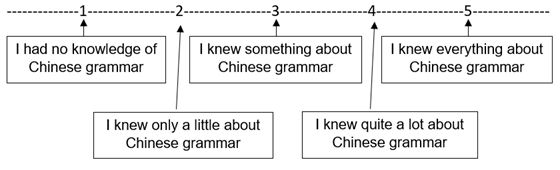
    First of all, I would like you to consider this question – how much knowledge of Chinese grammar did you have as a child before you started school? You have five options to choose from:

    It is quite a difficult question to answer, so I will try to help answer it at the end of the post.

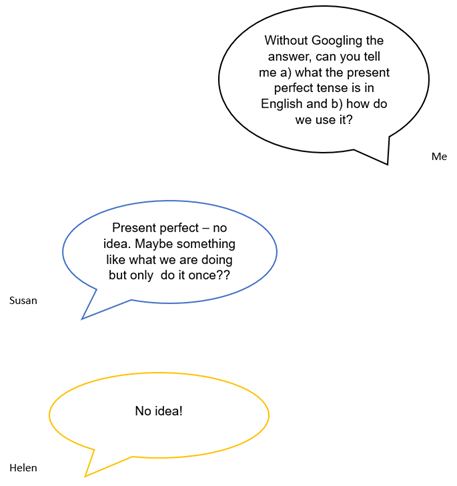
    Secondly, I want you to think about this WhatsApp conversation I had with my two sisters a while ago. Both my sisters are educated native English speakers and I asked them the following question about English grammar:

    As you can see from the answers above, neither of my sisters have any idea what the present perfect is. Nor are they able to explain what it is or how to use it. However, they both speak excellent English and can use the present perfect tense in conversation without ever making any mistakes. So how is it possible that they can use the present perfect but cannot explain what it is?

    The difference is because of different types of language knowledge.

    Both of my sisters have very good implicit knowledge of the present perfect tense, but they do not have very good explicit knowledge of the present perfect tense.

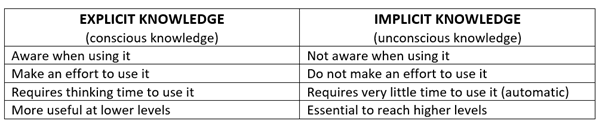
    Here is a summary of these two different types of language knowledge:

    Characteristics of explicit and implicit language knowledge

    We use both types of language knowledge when communicating but implicit language knowledge is much more useful, especially when:

    • we do not have time to think about our language use, i.e. speaking and listening
    • we do not have any control over language use, i.e. reading and listening

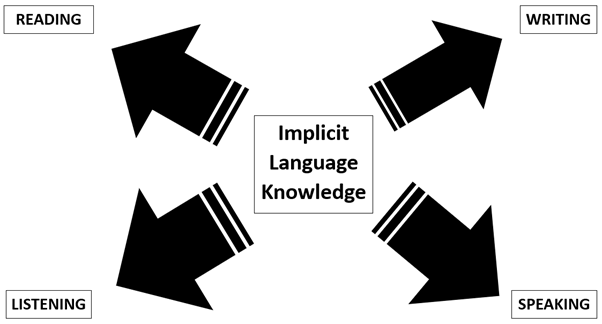
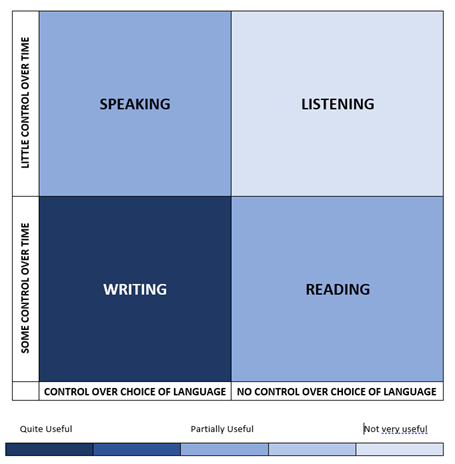
    The diagrams below show my (unscientific) attempt to show how useful the different types of language knowledge can be.

    Relationship between explicit language knowledge and the four skills
    Relationship between implict language knowledge and the four skills

    As you can see, the arrows in the diagram show that implicit language knowledge is more useful than explicit language knowledge for all four skills, especially listening. Explicit language knowledge is more useful for those skills when we have time to think and can control the language used, such as writing (time and control) and to a lesser extent, reading (time but no control). Explicit language knowledge can be useful at times when speaking (little time but some control) too but if you rely on it too much, then it will slow you down a lot and you will not be fluent. Explicit language knowledge is almost useless when listening as it is the only skill where you have little time and cannot control the language use. However, even though explicit language knowledge can be useful, to be successful in all skills (including reading and writing), you will need to mostly use implicit language knowledge.

    Usefulness of explicit language knowledge in four language skills

    In my opinion, explicit language knowledge about vocabulary is likely to be much more useful than explicit language knowledge about grammar. There are a few reasons why I think that:

    • Vocabulary has a much more significant impact on making meaning clear in communication. You are much more likely to misunderstand when reading or listening or be misunderstood when speaking or writing due to problems with vocabulary knowledge compared to problems with grammar knowledge.
    • Vocabulary is easier to remember and easier to apply in speaking and writing. A lot of grammar rules are quite complicated and abstract and so are difficult to apply when speaking or writing, whereas explicit vocabulary knowledge is easier to remember and apply.
    • Focusing on developing explicit vocabulary knowledge will have more of an effect in helping you to understand more difficult texts. Explicit grammar knowledge will not help so much in improving your reading and listening level.
    • Explicit grammar knowledge is not so useful in spoken communication. A lot of grammar in textbooks is based on written texts but the kind of grammar used in spoken communication is different to the grammar used in written communication. Therefore, the importance of ‘traditional grammar knowledge’ is less important in spoken texts. However, vocabulary knowledge is still very useful and necessary in both kinds of texts (spoken and written).

    So, coming back to the original question at the beginning of the blog post about your knowledge of Chinese grammar when you started school, the answer depends on what kind of language knowledge is being referred to. As with my sisters, it is likely that you had a lot of implicit language knowledge of Chinese grammar but very little explicit language knowledge of Chinese. Today, you are likely to have much more explicit language knowledge of Chinese grammar but this knowledge is still tiny compared to the implicit language knowledge of Chinese grammar that allows you to communicate freely with very little effort. The aim in your English learning is to be able to get as close as possible to how you are able to communicate in Chinese. To do this, you should focus mainly on developing your implicit language knowledge of English. I will show you how you can do this in the next blog post.

    References:

    Ellis N.C. (2017) Implicit and Explicit Knowledge About Language. In: Cenoz J., Gorter D., May S. (eds) Language Awareness and Multilingualism. Encyclopedia of Language and Education (3rd ed.). Springer, Cham.