This is a very difficult question with no simple answer. The time it takes to learn a language can depend on many different things. Here are three important factors that can influence the answer:
Factor 1: How ‘learning’ is defined
There are different ways of measuring someone’s ability to learn another language. For example, do you want to measure knowledge of language, such as grammar and vocabulary or ability in the four different skills of reading, writing, speaking and listening, or maybe both at the same time?
When it comes to language knowledge, it also depends on whether you are measuring implicit or explicit language (more about that in a later blog post). Of course, there are also good ways and not so good ways of testing language knowledge and the different language skills, so it’s quite complicated.
One of the most common ways to measure language ability is by using the Common European Framework of Reference (CEFR). The CEFR uses ‘Can Do’ statements to measure what language learners can do in the four different skills (reading, writing, speaking and listening). For instance, at A2 a learner can ‘use simple techniques to start, maintain or end a conversation’, and at C1 a learner can ‘select a suitable phrase to preface their remarks appropriately in order to get the floor, or to gain time and keep the floor whilst thinking’.
There are six levels in the CEFR:
- A1 (Beginner) – Can communicate in basic English with the help of the listener
- A2 (Elementary/Pre-Intermediate) – Can communicate in English within a limited range of contexts
- B1 (Intermediate) – Can communicate essential points and ideas in familiar contexts
- B2 (Upper-Intermediate) – Can use English effectively, with some fluency, in a range of contexts
- C1 (Advanced) – Able to use English fluently and flexibly in a wide range of contexts
- C2 (Proficiency) – Highly proficient – can use English very fluently, precisely and sensitively in most contexts
Information taken from: https://englishprofile.org/?menu=cefr-for-teachers-and-learners
The CEFR is intended to be used as a general guide that can be used in a wide variety of situations. However, if your aim is to learn English to use in a specific situation, such as for studying or for work, then it is likely that it would take a little longer to learn in order to become familiar with the specific language features that are needed in your place of study or work.
Factor 2: The Learning Environment
The learning environment is another important factor that will influence how quickly another language can be learnt. Learning environment includes:
- LEARNING CONTEXT – Being in an environment where you have more opportunities outside of class to communicate in English are likely to help you learn faster, e.g. by studying in a country where English is widely spoken.
- TEACHING METHODOLOGY – There are many things that a teacher does (if you have one) that could impact on how quickly you learn. For example, what kind of activities and tasks your teacher uses in class to help you develop in all four skills. How the teacher creates a positive atmosphere for learning and the ability to give appropriate feedback are also examples of factors that are likely to affect how quickly you learn.
- INTENSITY OF PROGRAMME – Language courses with only a few hours of study per week with little self-study provide fewer opportunities for reviewing skills and language. Therefore, these courses are likely to be less effective in helping learners to remember the skills and language learnt in class. On the other hand, more intensive courses allow quicker review of these skills and language, so learners are more likely to remember what they have learnt in lessons.
- GROUP DYNAMICS – If you are learning in a class, then the relationships and interactions within the class are likely to be important. Classmates can give useful feedback, provide assistance and advice as well as motivation and more opportunities for interaction (both in and outside of class).
- ACCESS TO RESOURCES – Learners who have access to a range of appropriate resources and learning materials are also likely to learn more quickly. Those resources that provide extra opportunities for input (reading and listening) at an appropriate level outside of class are likely to be especially useful.
Factor 3: The Individual Learner
- INDIVIDUAL DIFFERENCES – Differences in age, gender, personality, learning ability, motivation, etc. can all affect how quickly you learn. For example, younger learners seem to be better at learning pronunciation features of English compared to older learners. However, older learners are better at using skills and strategies to help them learn English compared to children. Motivation and personality are also factors that are likely to affect how quickly you learn, e.g. highly-motivated individuals who look for opportunities to communicate with other people in English are likely to learn faster.
- BELIEFS ABOUT LANGUAGE AND LANGUAGE LEARNING – Learners who hold negative beliefs about their ability to communicate successfully in another language are likely to be slower in learning a language. Similarly, if the learner has negative feelings about the culture where English is spoken, this could also have a negative impact on how quickly a language can be learnt.
- CLEAR LEARNING OBJECTIVES – Learners with clear goals and of their reasons for learning a language are likely to learn more quickly than those without clear goals and objectives. For example, learners studying for an exam such as the IELTS or TOEFL are likely to have a clearer goal and so may learn more quickly as a result.
- FIRST LANGUAGE – The differences between English and the first language of a learner are likely to have quite a big impact. For examples, similarities in vocabulary can help many speakers of other European languages to learn English faster. On the other hand, learners whose first language is written in a different script to English (e.g. Japanese, Chinese, Korea, Arabic, Thai, etc.) are likely to learn English more slowly. As an example, the Foreign Service Institute (an American government department) put different languages into categories to show how easy or difficult they are to learn for native speakers of English. European languages such as Spanish, French and Italian are in the easiest group whereas Asian languages such as Chinese, Japanese, Korean and Arabic are in the most difficult group. Therefore, a native English speaker who is learning Spanish can make much more progress than if they are learning Chinese. The same is likely to be true in reverse, i.e. A native Chinese speaker will make more progress at learning Japanese than they would at learning English. However, there is some evidence that these differences are much more important at lower levels than at higher levels, so it’s not all bad news if you are learning English – you just need to be more patient when you are at a lower level
Information taken from: https://www.cambridge.org/elt/blog/wp-content/uploads/2018/10/How-long-does-it-take-to-learn-a-foreign-language.pdf
As can be seen from the above information, there is no easy answer to this question, but we can make some general predictions using information from this paper from Cambridge University Press (CUP) called ‘How long does it take to learn a foreign language?’ and information from Cambridge Assessment.*
First of all, it is important to be aware of how hours are counted. Both the paper from CUP and the information from Cambridge Assessment use the term ‘Guided Learning Hours’, which means hours of class time and hours spent doing guided self-study (i.e. homework set by the teacher). It does not include time spent by the learner doing self-study that a teacher has not set for homework. Obviously, it also depends how this time is spent. In my opinion, time spent doing grammar exercises is probably not as useful as communicating in English with the help of a teacher.
One interesting thing to notice is that it is generally accepted that it is easier to make more progress at lower levels than at higher levels. Below is a table taken from the paper from CUP, which shows that for adult learners with high levels of motivation and share the same L1 script as English (e.g. French, Spanish, German, etc.), approximately 90-100 hours are required to move from A1 to A2 whilst around 300-400 are needed to move from C1 to C2. These hours are likely to be higher for Taiwanese students though as obviously English and Chinese have different writing systems. However, remember that at higher levels, the first language has a much smaller impact than at lower levels.

Table taken from: https://www.cambridge.org/elt/blog/wp-content/uploads/2018/10/How-long-does-it-take-to-learn-a-foreign-language.pdf
It is also interesting to see that Cambridge Assessment makes slightly different predictions to Cambridge University Press (though Cambridge Assessment does not include a learning context).
Here is the table from Cambridge Assessment:
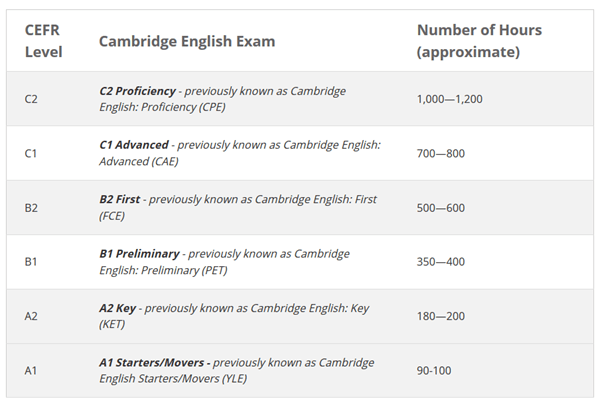
Taken from: https://support.cambridgeenglish.org/hc/en-gb/articles/202838506-Guided-learning-hours
In summary, it is difficult to give a precise figure, but for levels between A2 and C1, an average figure of about 200 hours to move up one level (e.g. B1 to B2) seems to be the most optimistic prediction.


Leave a reply to How long does it take to increase my IELTS score? – Self-Study English Cancel reply