Tag: implicit knowledge

  • How to get good quality input – Extensive reading

    In the last blog post, I wrote about the importance of getting lots of input in order to develop your implicit language knowledge. There is also another blog post that shows how a high level of implicit language knowledge is essential for effective communication in English.

    However, getting the right quality of input is also very important. Probably the most important aspect is making sure the input (through reading and listening) that we receive is at the right level. If we cannot understand the input that we receive, then we will not correctly process the information. Here, processing means being able to understand the meaning of the message in the input and matching it in our brains (mostly unconsciously) to the language used to create the message. However, if we cannot process the information, our implicit language knowledge will not develop. Therefore, it is very important that the language we receive in the input is at the right level.

    I find that this is one of the most common problems that many learners have when trying to learn English independently. They try to watch TV shows, films, YouTube videos or read magazines, websites, newspapers, etc. in English but quickly realise that this is often too difficult and so they don’t understand enough to find it enjoyable. The problem is that most of what these learners are trying to watch, listen to or read in English is not aimed at language learners – it is mostly aimed at people who speak English as a first language. There is rarely any attempt to make it easier for language learners to understand the texts and so it is obviously often very difficult to understand. Therefore, for most English learners, it is better to use input that is specifically aimed at language learners.

    One of the best ways to do this is through extensive reading and listening. Extensive reading is defined as “an approach to language learning that encourages students to read a large amount of books, or other reading material, that is relatively easy for them to understand. Ideally, the books should be easier than their current reading level so that they can read quickly, without having to look up words in a dictionary”. One of the best ways of doing extensive reading is by using graded readers. These are books that have been especially written or adapted for leaners of English at different levels. This means that learners can choose from books that are at a suitable level for them.

    A quick way to find out your extensive reading (or listening) level by going to the ‘Check my Level’ section of the student registration page on the ER Central website:

    When you click on ‘Check My Level’, you will see the following image:

    You should place your mouse arrows over one of the numbers and start reading. If you think you know all the words in the text, you can try a higher level. If there are three or more words that you don’t know, then you should try a lower level. The right level for you should have one or two words that you don’t know. If your level is higher than 13, then click the arrow on the right to reveal more levels (there are 20 in total). You can try reading at different levels and see which one you find you are comfortable with. If you are not sure, it’s probably better to go down a level.

    Once you know your extensive reading level, you can now look for reading material that is at the right level for you. On the same website as the level test, you can find lots of reading and listening texts that are organised by level and category (e.g. crime, romance, true story, etc.). However, most of these texts are quite short and you probably want to read something longer. Another website that you can use, which has longer texts, is the following: https://english-e-reader.net.

    Again, you can search by level to help you find a book that is at a suitable level for you.

    If you study at Intake, you can also find some books in the book case in the corner next to reception. The orange books and other books on the same shelf are fiction books and come in a range of levels. There are some non-fiction books in the coloured folders, but are probably too easy for higher level learners. If you study at university, your library might also have some graded readers that you can borrow. Alternatively, you might be able to find some in Taipei public libraries.

    If you are a higher level student and want something a bit more challenging but still simplified for language learners, you can try some of the mid-frequency graded readers available from Victoria University.

    If you are preparing for the IELTS exam, then you might also want to focus on texts that are more ‘academic’ than reading a novel. In this case, you might want to try reading some non-fiction books instead of novels as the topic and style of the writing in non-fiction will be closer to the IELTS exam compared to when reading a novel. In this blog post, I have given some suggestions for the kinds of non-fiction texts that advanced learners could read and listen to in order to help them prepare for the IELTS exam.
  • How to develop implicit language knowledge – Focusing on input

    In the previous blog post, I attempted to explain the difference between implicit and explicit language knowledge. I also tried to show why it is much more important for language learners to focus on developing implicit language knowledge rather than explicit language knowledge. Therefore, in this blog post, I am going to try and show you how you can develop your implicit language knowledge.

    When using English to develop implicit language knowledge, it is important to make sure that you are doing activities that involve ‘real’ communication, or what is often called ‘communicative’ activities. This means that you are not just trying to ‘study’ the language by doing grammar or vocabulary exercises, but actually doing something where the focus is on the meaning. For example, this could include:

    • Talking to a friend in English about everyday topics, e.g. complaining about the weather, asking for advice about restaurants in your area, etc.
    • Watching a film or TV series on Netflix/YouTube, etc. for your own enjoyment
    • Reading a textbook, journal article, website, etc. to gain some knowledge about a specific subject, e.g. for your work or studies.

    These are just a few examples of the many different ways in which you might use English for a real-world purpose that makes these activities ‘communicative’. Basically, almost anything that you might normally do in Chinese that you then do in English instead would count as a communicative activity. However, you probably wouldn’t read or listen to a text in Chinese and then try to learn some grammar or vocabulary from the text, unless perhaps you happen to be studying Chinese language at university. You also probably wouldn’t do exercises in Chinese to help you learn Chinese grammar or vocabulary and then do an activity to practise using this grammar or vocabulary. Doing the same kinds of activities in English, where the focus is on using a specific piece of grammar or vocabulary rather than on the message you are trying to communicate, also wouldn’t really be a communicative activity. This is because the purpose of these types of activities would be to focus on the language rather than the message, but ‘communicative’ activities have a focus on the message, not the language.

    When taking part in these kinds of ‘communicative’ activities that I have described above, you are interacting with input (reading and listening). Meaningful interaction (having a real-world purpose to communicate) with input is essential to help develop your implicit language knowledge. The reason for this is that meaningful interaction with input can help us to process language. When we process language, our brains are making a connection between the form (language, e.g. grammar and vocabulary) and the meaning of the message that is being communicated. If we are doing grammar exercises, for example, there is unlikely to be any meaningful message being communicated because the focus is on the language and so we are much less likely to process the language. When our brains process language, this helps to subconsciously (without awareness) build up our implicit language knowledge.

    So, you can see from what I have written above that getting lots of input is really important to help us develop implicit language knowledge. However, it’s not only the quantity of input that is important but also the quality of that input. In the next blog post, I will share some advice about how to ensure that you can get better quality input.

  • Why doing grammar exercises is (mostly) a waste of time – Explicit vs implicit language knowledge

    Many people know that doing lots of grammar exercises from a textbook is not very useful to help you become fluent in English. However, it can sometimes be difficult to explain why doing grammar exercises is not very useful. After all, we need grammar knowledge to help us communicate in English, so why is doing grammar exercises and learning grammar rules not very helpful?

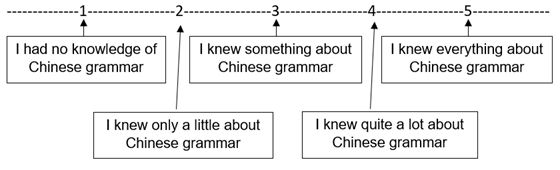
    First of all, I would like you to consider this question – how much knowledge of Chinese grammar did you have as a child before you started school? You have five options to choose from:

    It is quite a difficult question to answer, so I will try to help answer it at the end of the post.

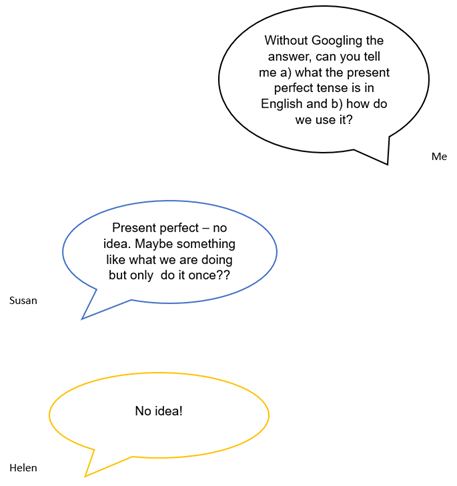
    Secondly, I want you to think about this WhatsApp conversation I had with my two sisters a while ago. Both my sisters are educated native English speakers and I asked them the following question about English grammar:

    As you can see from the answers above, neither of my sisters have any idea what the present perfect is. Nor are they able to explain what it is or how to use it. However, they both speak excellent English and can use the present perfect tense in conversation without ever making any mistakes. So how is it possible that they can use the present perfect but cannot explain what it is?

    The difference is because of different types of language knowledge.

    Both of my sisters have very good implicit knowledge of the present perfect tense, but they do not have very good explicit knowledge of the present perfect tense.

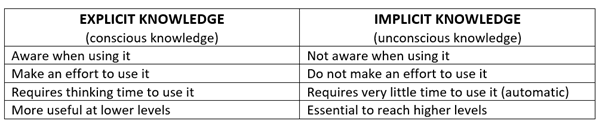
    Here is a summary of these two different types of language knowledge:

    Characteristics of explicit and implicit language knowledge

    We use both types of language knowledge when communicating but implicit language knowledge is much more useful, especially when:

    • we do not have time to think about our language use, i.e. speaking and listening
    • we do not have any control over language use, i.e. reading and listening

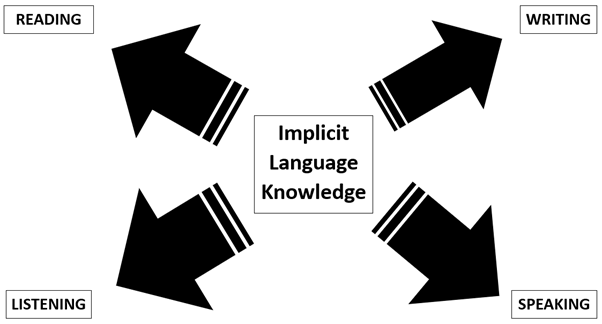
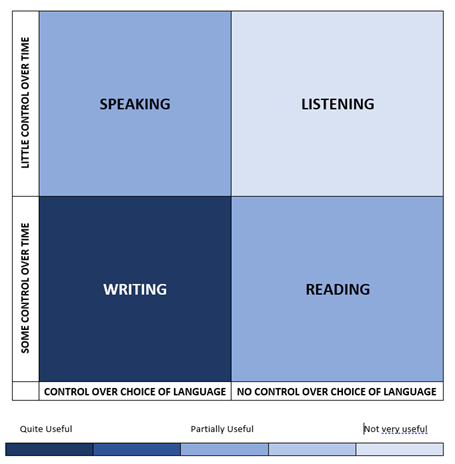
    The diagrams below show my (unscientific) attempt to show how useful the different types of language knowledge can be.

    Relationship between explicit language knowledge and the four skills
    Relationship between implict language knowledge and the four skills

    As you can see, the arrows in the diagram show that implicit language knowledge is more useful than explicit language knowledge for all four skills, especially listening. Explicit language knowledge is more useful for those skills when we have time to think and can control the language used, such as writing (time and control) and to a lesser extent, reading (time but no control). Explicit language knowledge can be useful at times when speaking (little time but some control) too but if you rely on it too much, then it will slow you down a lot and you will not be fluent. Explicit language knowledge is almost useless when listening as it is the only skill where you have little time and cannot control the language use. However, even though explicit language knowledge can be useful, to be successful in all skills (including reading and writing), you will need to mostly use implicit language knowledge.

    Usefulness of explicit language knowledge in four language skills

    In my opinion, explicit language knowledge about vocabulary is likely to be much more useful than explicit language knowledge about grammar. There are a few reasons why I think that:

    • Vocabulary has a much more significant impact on making meaning clear in communication. You are much more likely to misunderstand when reading or listening or be misunderstood when speaking or writing due to problems with vocabulary knowledge compared to problems with grammar knowledge.
    • Vocabulary is easier to remember and easier to apply in speaking and writing. A lot of grammar rules are quite complicated and abstract and so are difficult to apply when speaking or writing, whereas explicit vocabulary knowledge is easier to remember and apply.
    • Focusing on developing explicit vocabulary knowledge will have more of an effect in helping you to understand more difficult texts. Explicit grammar knowledge will not help so much in improving your reading and listening level.
    • Explicit grammar knowledge is not so useful in spoken communication. A lot of grammar in textbooks is based on written texts but the kind of grammar used in spoken communication is different to the grammar used in written communication. Therefore, the importance of ‘traditional grammar knowledge’ is less important in spoken texts. However, vocabulary knowledge is still very useful and necessary in both kinds of texts (spoken and written).

    So, coming back to the original question at the beginning of the blog post about your knowledge of Chinese grammar when you started school, the answer depends on what kind of language knowledge is being referred to. As with my sisters, it is likely that you had a lot of implicit language knowledge of Chinese grammar but very little explicit language knowledge of Chinese. Today, you are likely to have much more explicit language knowledge of Chinese grammar but this knowledge is still tiny compared to the implicit language knowledge of Chinese grammar that allows you to communicate freely with very little effort. The aim in your English learning is to be able to get as close as possible to how you are able to communicate in Chinese. To do this, you should focus mainly on developing your implicit language knowledge of English. I will show you how you can do this in the next blog post.

    References:

    Ellis N.C. (2017) Implicit and Explicit Knowledge About Language. In: Cenoz J., Gorter D., May S. (eds) Language Awareness and Multilingualism. Encyclopedia of Language and Education (3rd ed.). Springer, Cham.