Tag: IELTS

  • Why you should use official materials to prepare for the IELTS exam

    When preparing for anything in life, it is important to get the best possible preparation. For example, if you are going to run a marathon, you need to do lots of long-distance running. Likewise, if you’re going to do the IELTS test, then you also need to do lots of practice IELTS questions. However, if you were going to run a marathon in say Singapore (where it is hot and humid all year), it probably isn’t a good idea to only do your training during the winter in Europe as the weather conditions are likely to be very different and this will probably have a negative effect on your performance during the day of the marathon.

    The same is true of the IELTS test. There are lots of practice materials available, but most of them are not official materials. Some might be well written and be quite similar to the real exam, but some might not be very well written and be quite different to the real exam. There are a few ways that some practice IELTS materials might be different to the real exam:

    • questions are too difficult
    • questions are too easy
    • questions have more than one possible answer
    • questions are confusing or badly written
    • question types are different to those in the real exam
    • typos/language errors in texts

    These are just some examples of problems (there are probably more) that there could be with inauthentic practice IELTS materials. As a result of these issues above, you might have inaccurate information about your current language level (and your ability to get a particular score) as well as the types of questions you will face in a real IELTS exam. This could have the effect of negatively impacting your performance in the IELTS exam and may even mean you have to take the exam again because you did the exam before you were properly prepared.

    The best and by far the widest source of authentic IELTS practice tests is its series of books that are released every year (IELTS 20, IELTS 19, etc.) which have four practice tests in each book. They are a little expensive, but if you can borrow some or share the cost with a friend, then they are definitely worth using. However, since the paper-based IELTS test is no longer available in Taiwan, you probably should do some online practice tests too. Currently, there are two free tests available from official sources – one from the the IDP IELTS website (answers at the bottom of the page) and the other from the British Council IELTS website (unfortunately, no answers are available for this one).

    There are also some practice questions for each of the different question types on the official IELTS website, but it is harder to use these questions to calculate your expected score as they are individual parts of the test rather than a whole test (though they could still be useful practice).

    There are some preparation materials that appear to be official materials, but are actually not authentic tests. For example, Cambridge University Press produce various IELTS textbooks such as the Complete IELTS series and the Mindset series of books. All of these books are written for different levels of students, so the questions might be easier (or more difficult) than the real IELTS exam. Similarly, the British Council has an online platform called IELTS Ready, which has six free online mock tests but some candidates have complained of the reading and listening questions being more difficult than the real exam and I can see that one of the writing exam questions (Mock Test 3, Task 2) doesn’t even have a clear question, so I would advise against relying on either of these sources for authentic IELTS practice tests.
  • How to Use Sample IELTS Writing Answers

    I have already shown how you can use IELTS reading and listening texts to help you develop your language skills to help you prepare for the IELTS test, and in this blog post, I will show you how you can use sample writing answers to help you prepare for the IELTS writing test.

    First of all, before reading a sample answer, it would obviously be beneficial to think a little about the question or task. Even if you don’t want to write an answer yourself first, you can still take some time to think about the question and what you would include in your answer. For part 1, this might include:

    • thinking about how to change the language in the question to write the first sentence
    • identifying the main features and thinking about what information to include in an overview
    • thinking about what specific details you would include and what data to describe
    • thinking about how you would organise these specific details into two or three paragraphs
    • thinking about what language you could use to describe the data, map changes, process, etc.

    For part 2, this might include:

    • understanding what you need to do to answer the question
    • thinking about your opinion on the topic
    • thinking about what ideas you could include and how to develop these ideas
    • thinking about how to organise these ideas into paragraphs
    • thinking about what language you could use to show your opinion and link ideas together

    Once you have done these, you can then read a sample answer and compare against your own ideas and make a note of any differences. For part 1 answers, probably the most useful thing you can do is focus on what information is included in the overview, identify what data has been reported and identify any language that has been used to describe the data, map changes or stages in a process.

    For part 2, the most useful thing to do probably involves identifying the overall opinion, the organisation of the main body, how ideas have been developed with reasons and examples in each paragraph and any language that has been used to show opinion and link ideas together.

    However, when using sample answers, you need to make sure that you are using reliable answers as there is a lot of material available that is of questionable quality. Here are some websites that I think have quite reliable samples answers that you can be helpful for you:

    Part 1 Sample Answers

    IELTS Buddy (Part 1)

    English Exam (Part 1)

    IELTS Focus (Part 1)

    Part 2 Sample Answers

    IELTS Buddy (Part 2)

    English Exam (Part 2)

    IELTS Focus (Part 2)

  • Useful Websites for Vocabulary Learning – Academic Vocabulary

    In previous posts, I have explained the importance of developing implicit language knowledge in order to become fluent in English at a high level. We can do this mostly by getting the right kind of input (see here, here and here). By doing lots of reading and listening we are learning vocabulary incidentally (implicitly). In other words, we are developing our implicit vocabulary knowledge by reading and listening for meaning rather than through any deliberate focus on learning vocabulary. This type of learning is obviously very important, but it can also be supported through learning vocabulary deliberately (explicitly). Here, we are developing explicit vocabulary knowledge, but doing this can also help to develop our implicit vocabulary knowledge. It does this because it: a) helps to give us more repetitions, so that we learn faster, and b) helps us to be able to read and listen to more difficult texts, therefore allowing us to get more input, which we know helps develop our implicit vocabulary knowledge.

    Remember though that implicit language knowledge is really important for developing fluency in a foreign language, so it is important that deliberate vocabulary learning is used in addition to getting lots of input, and not a replacement for it. In my opinion, you should still spend considerably more time on getting input through reading and listening compared to deliberate vocabulary learning.

    However, when doing deliberate vocabulary learning, it is very important that it is targeted, so that the most useful kind of vocabulary is learnt. Obviously, for students who are preparing for the IELTS test, vocabulary that is frequent in the texts for the reading and listening components will be useful as well as vocabulary that can be used in the speaking and writing components.

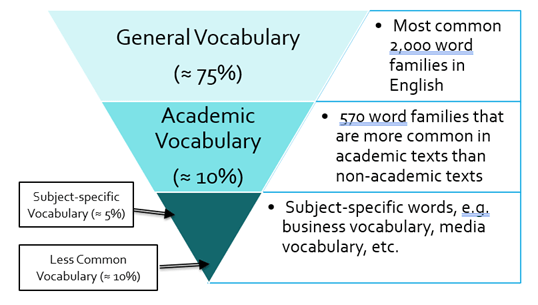
    One way we can help to focus our vocabulary learning is by thinking about the type of vocabulary that is likely to be seen in reading and listening texts as well as be useful to use in the writing and speaking components. One way of doing this is by looking at some research (see Coxhead, 2000) into academic texts. This research showed that these texts generally had the following profile:

    This diagram helps to show that we need to focus on the most common general words in English as these account for around three-quarters of all words in an academic text. However, these 2,000 words that are referred to above are taken from a word list that was created nearly seventy years ago (see West, 1953), so it might be a good idea to find a more up-to-date list of words to focus on.

    Furthermore, most learners who are preparing for IELTS will already know most of these 2,000 words, so I am going to focus on learning ‘academic’ words in this post. The previously mentioned research (see Coxhead, 2000) analysed lots of different academic texts across lots of different academic subject areas (e.g. Medicine, Law, Economics, English Literature, Chemistry, History, etc.). This analysis was used to create a list of words that are common in all different academic subject areas. The result was the creation of the Academic Word List (AWL), which is a list of 570 word families (e.g. analyst, analyse, analysis, analytic, etc. all count as one word family). You can find a list of these word families here: https://www.eapfoundation.com/vocab/academic/awllists/

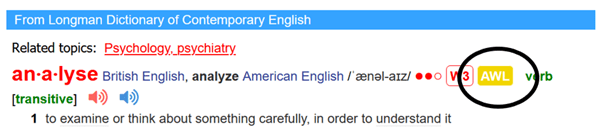
    Some of these words, you will already know and some of them will be new to you. Apart from looking at the list above, there are a couple of ways that we can check whether a word appears on the Academic Word List (AWL). The first way is by checking in the Longman dictionary. When we search for a word in this dictionary, it will tell us if a word appears on the Academic Word List by indicating ‘AWL’ in a yellow box. If we can see this yellow ‘AWL’ box, this indicates that the word appears on the Academic Word List, and is therefore quite a useful word to learn, e.g. see below for ‘analyse’:

    Taken from the Longman Dictionary of Contemporary English (https://www.ldoceonline.com/)

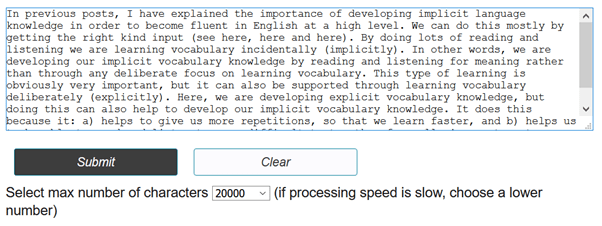
    This is probably the best way to check any new words that you might see in your textbook or any texts printed on paper or in a book. However, if you are reading an online text, it can be better to use the AWL highlighter, which will highlight any words from the AWL when you copy the text into the box on the following page: https://www.eapfoundation.com/vocab/academic/highlighter/

    Using the first paragraph from this blog post as an example, you can see below that several words have been highlighted. You will notice that some are coloured grey and some are coloured orange:

    Taken from: https://www.eapfoundation.com/vocab/academic/highlighter/

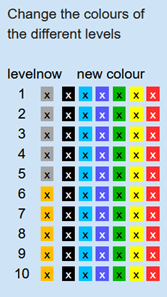
    If you look on the sidebar on the left, you can see that these colours relate to different ‘levels’. These levels (1-10) are organised by frequency. In other words, level 1 has the most frequent academic words and level 10 has the least frequent academic words.

    Now obviously, it would be nice to know all of these words on the Academic Word List, but there are a lot to learn, so that could be quite a big task. It is therefore better to focus your vocabulary learning on the most useful words from the list, i.e. levels 1, 2, 3, etc. rather than say levels 9 and 10. However, where you start learning on the list will depend on how many words you already know from the list (most learners will probably already know quite a lot of words from level 1).

    When using this tool, you can change the colours for each level to help you identify the words from the levels that you want to focus on.

    Before finishing, I should mention that the Academic Word List is not the only list of academic words, but it is probably the most well-known. If you are interested in other lists of academic words, you might want to read this journal article (Therova, 2020). One of the lists mentioned in the article is from Oxford Dictionaries called the Oxford Phrasal Academic Lexicon (OPAL), which has more words than the Academic Word List and also divides words into spoken and written academic words. It also has different sublists, thus allowing you to target your vocabulary learning.

    In a later blog post, I will show you some apps that you can use to help you learn the words from the Academic Word List. However, in the next blog post, I will show some tools that help to focus your vocabulary learning on ‘general’ vocabulary.

    References

    Coxhead, A. (2000). A New Academic Word List. TESOL quarterly, 34(2), pp213-238.

    Therova, D. (2020). Review of Academic Word Lists. TESL-EJ, 24(1). Available at: https://www.tesl-ej.org/wordpress/issues/volume24/ej93/ej93a5/

    West, M. (1953). A General Service List of English Words. London: Longman, Green and Co.

  • High quality input for advanced learners to help prepare for the IELTS exam

    In the previous blog post, I mentioned how extensive reading (especially graded readers) can be a useful source of input. One of the advantages of using graded readers is that they are available at different levels and so it is easy for people of all abilities to find a suitable book. However, if you are an advanced level learner of English, you might be ready to read and listen to texts that have not been adapted for learners. Obviously, this can be quite difficult, but it also gives you a much wider range of texts to choose from.

    For the IELTS exam, you will need to read ‘three long texts which range from the descriptive and factual to the discursive and analytical. These are taken from books, journals, magazines and newspapers.’ Obviously, the word ‘factual’ is important here, so if you want to read texts that are similar in style to the IELTS test, then you need to be careful about what kinds of texts you choose to read.

    First of all, you probably wouldn’t want to focus on reading novels as these are not factual texts. I would also advise against reading anything too political as the IELTS exam doesn’t really do politics. Also, news articles don’t seem to appear in the IELTS test as they go out-of-date very quickly. You probably want to focus more on texts that cover a range of topics but are perhaps written in a slightly more formal style for an educated audience and will still be relevant at least a year after they have been written.

    There are quite a few magazines that report studies on a range of topics for a non-specialist audience. These kinds of magazines are easier to read than academic journals and are probably quite similar in style and language to many of the texts that you might find on an IELTS exam. They are also not too long to read, so will be similar in length to the IELTS exam. Here are some links to a few different science magazines that might be interesting and useful to read:

    https://www.newscientist.com/

    https://www.scientificamerican.com/

    https://www.nationalgeographic.com/magazine/

    https://www.psychologytoday.com/intl

    https://www.sciencemag.org/

    https://www.sciencefocus.com/

    https://www.discovermagazine.com/

    https://www.the-scientist.com/

    When looking for articles to read, it would be a good idea to try and find articles that are not too specific and are of general interest to most people as these are the kinds of texts that are likely to appear in the IELTS exam.

    You can also choose appropriate sections from newspapers and online news sites to help you find suitable articles, e.g. from the BBC website, you might find some interesting articles from any of the Culture, Future, Travel or Business sections. You can also use newspapers to find interesting articles in the science sections of newspapers such as The Guardian, The New York Times and The Australian. Culture, Travel and Lifestyle sections might also have interesting and useful articles from online newspapers.

    When it comes to listening material, the BBC also has a wide range of podcasts to choose from. If you are not familiar with podcasts, you will want to download a podcast player to your phone, so that you can search for podcasts and add them to your feed. You will then be notified when a new episode is available. I use an app called Player.fm, which works well for me but there are lots of different ones available.

    The BBC has lots of different podcasts available, so one of the best places to start might be the BBC World Service, which is aimed at people around the world rather than just a British audience. One podcast that is quite interesting is called The Big Idea, which has a range of interesting topics that I could imagine appearing in the IELTS exam. It is also quite short, so you could easily listen to it in less than fifteen minutes, e.g. on the MRT or bus to work, university, etc. Unfortunately, they have stopped producing episodes, but there are still plenty of old episodes to listen to. Another short BBC podcast that is no longer produces new episode, but has a large number of older episdoes to listen to is 50 Things that Made the Modern Economy. It deals with a range of topics related to inventions, ideas and innovations, so is likely to cover many topics that would appear on the IELTS test.

    Another short podcast from the BBC that I like to listen to is called More or Less: Behind the Stats. Whilst it does talk about Coronavirus rather a lot and is a bit biased towards UK news, it obviously talks a lot about statistics too so could be quite useful to help you review describing statistics (part 1 writing).

    A few other BBC podcasts that I have listened to are: Deeply Human (about the science behind human experiences), Science in Action (about science in the news), Discovery (about science in general), Crowd Science and The Inquiry (about ideas in the news).

    Obviously, for advanced learners, there are lots of different material available that could be useful and interesting for you, so if you have any suggestions, then please feel free to post them in the comments.

  • How long does it take to increase my IELTS score?

    As with learning English, there are a variety of factors that can influence how long it takes to increase your IELTS score. However, I will attempt to use a variety of sources that should help to give an estimate.

    The most useful source for this is a research article that investigated how much students improved their IELTS score after 10-12 weeks of a full-time English course (about 200-240 hours) in private language schools in Australia and New Zealand (Elder and O‘Loughlin, 2003). The research showed that students increased their score by an average of about 0.6 of a band overall after a course of 10-12 weeks. However, there were differences in how much students improved in the different sections. On average, students improved their score by almost 0.8 of a band in listening whereas it was only 0.4 for reading. There were also big differences between individual students as some students managed to increase their score by quite a lot in this period whilst some students saw very little improvement in their score.

    As with language learning in general, according to the research, it seems that it is easier to make progress at the lower band scores. For students who started the course at band 6, they had a less than 50% of increasing their overall band score over the period of a 10-12 week course (Elder and O‘Loughlin, 2003). Interestingly, the study also showed that the most successful age group were those students who were aged 20-25.

    Another useful piece of research investigated score gains in the writing section of the IELTS test (Green, 2005). It also showed that students are more likely to increase their score at lower levels, e.g. a student with a 5.0 is more likely to increase their score by 0.5 of a band (to 5.5) compared to a student who already has a 6.5 and is trying to increase their score to 7.0. The article also notes how previously (before 2002), IELTS partners (Cambridge English Language Assessment, the British Council and IDP: IELTS Australia) used to provide the following statement about score gains:

    ‘It has been shown that individuals can take up to 200 hours to improve by one IELTS band’

    (IELTS, 2002, p22 cited in Green, 2005). However, Green advised that this advice could not be supported by evidence and IELTS no longer provide such information about how long it may take a candidate to improve their IELTS score.

    It is also quite useful to look at some different universities and how long they estimate that it takes to go up an IELTS band. Most universities in the UK offer pre-sessional English courses to students as an alternative to achieving the IELTS band score that they need for their chosen course. Most universities (especially those with a stronger reputation) suggest that for each 0.5 of a band that students are below their target score for their course, they would need 10 weeks of full-time study (about 200 hours) to get to the required level.

    For example, imagine you wanted to study at the University of Liverpool on a course that required 6.5 overall.  If you currently have an IELTS score of:

    • 4.5, you would need to study on a pre-sessional course for 40 weeks
    • 5.0, you would need to study on a pre-sessional course for 30 weeks
    • 5.5, you would need to study on a pre-sessional course for 20 weeks
    • 6.0, you would need to study on a pre-sessional course for 10 weeks

    It is similar for many other UK universities – see entry requirements for Leeds, Manchester, Sheffield, Birmingham and Nottingham.

    Obviously, as with the research outlined above from Australia and New Zealand, students taking an intensive pre-sessional course will be in an English-speaking country and so would get the benefit of being surrounded by English much of the time. The only drawback of such courses is that there is relatively little time for self-study for each hour of class time (students would normally have around four to five hours of classes per day from Monday to Friday). However, if you are learning for 6 hours a week, then there is more opportunity for self-study between lessons and so slightly fewer class hours might be needed than in the examples above (but more self-study).

    What is interesting is the difference between how long is suggested it might take to improve an IELTS score above compared to how long Cambridge Assessment and Cambridge University Press suggest it might take to move up one band on the CEFR, e.g. A2 to B1, B2 to C1, etc. It seems that these predictions are a lot more optimistic than for how long it takes to improve an IELTS score. One reason might be that the IELTS test is not just an assessment of general English level but an assessment of how well a candidate can communicate in an academic context. This is likely to mean extra preparation involved (e.g. learning how to do the writing part 1 and part 2 task) as well as learning more specific language that is common in academic contexts.

    However, I would guess that the biggest difference is to do with the first language of many students who take the IELTS test. Remember that the predictions by Cambridge Assessment (see here) were for learners in an ideal situation, e.g. learners who share the same writing script as English (e.g. French, German, Spanish, etc.) whereas most of the students who take the IELTS test and were involved in the studies mentioned were from either East Asia or the Middle East. This means that most candidates for the IELTS test are likely to have a first language (e.g. Arabic, Chinese, Japanese, etc.) that is very different to English and so would take longer to make progress in English.

    Overall then, it seems that a figure of about 200 hours of lessons is probably the best guess of how long is needed to increase by 0.5 of a band on the IELTS test on average for students who have Chinese as their first language. Obviously, it is possible to do it in less, but this depends on many factors (see here, here and here), and especially on how much effective self-study you are able to do.

    References:

    Elder, C., & O’Loughlin, K. (2003). Investigating the relationship between intensive English language study and band score gain on IELTS. International English Language Testing System (IELTS) Research Reports 2003: Volume 4, 207.

    Green, A. (2005). EAP study recommendations and score gains on the IELTS Academic Writing test. Assessing Writing, 10(1), 44-60.