What is the Intermediate Plateau? (And how to overcome it)

Many of you will be familiar with the word ‘plateau’ as a word that you can use to help you describe line graphs in part 1 of the IELTS writing exam. Here, according to the Longman Dictionary, plateau can be described as ‘a period during which the level of something does not change, especially after a period when it was increasing’. So, you might be able to guess that the ‘intermediate plateau’ refers to a period of time when a learner seems to make little progress and finds it difficult to reach an advanced level of English. In this blog post, I will try go give some reasons for the intermediate plateau and also suggest some solutions about how to overcome it.

First of all, the main reason for the intermediate plateau is that a comparison is being made with the lower levels of language learning. As a beginner with close to zero ability (in anything), it is usually quite easy to make progress fairly quickly and to also notice this progress, which brings a sense of achievement. This is because when you start out with no (or close to no) ability in something, it is almost impossible to not feel a sense of progress. After all, you cannot get worse if your ability started out at zero! However, once you get to intermediate level, you already have a level of ability and so your point of comparison is much higher, making it more difficult to notice any improvements in ability.
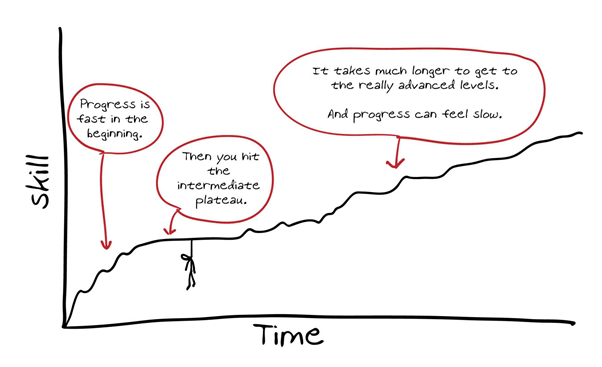
Taken from: https://www.betteratenglish.com/break-intermediate-english-plateau

Secondly, when you start out as a beginner, the words you learn are usually some of the most common words in a language and you will see these words over and over again (because they are the most common!). This means that you do not need to read or listen as much to get the repetitions you need to help these words to be stored in your long-term memory. Therefore, you need fewer hours of input (reading and listening) to help you progress to the next level. This is reflected in the research, as if you remember my final blog post about how long it takes to learn another language, it is suggested that it takes fewer hours to progress to the next level at lower levels of learning:
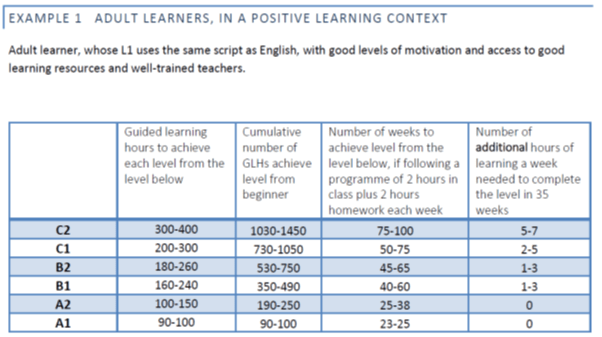
Table taken from: https://www.cambridge.org/elt/blog/wp-content/uploads/2018/10/How-long-does-it-take-to-learn-a-foreign-language.pdf

Another possible reason might be to do with motivation. When we start out learning something new, motivation is usually quite high at the beginning. However, over time it is quite natural that these levels of motivation begin to drop (often they are at a level that is unsustainably high to begin with) and so, with lower levels of motivation, it is normal that less time is spent on learning and it therefore takes longer to get through the intermediate stage compared to the lower levels.

It is also important to be aware that language learning does not progress as a straight line and so there will always be some ups and downs along the way, which may mean that progress is harder to see. For example, one indicator of an advanced learner is the ability to use more complex grammar and vocabulary. However, in order to be able to use more complex language in speaking and writing, learners need to try to use this new language. Obviously, in trying this new language for the first time, mistakes are made in the process (maybe more mistakes than previously), but these mistakes are just a natural (and even necessary) stage that learners need to go through in order to progress to the next level.

However, it is also possible that the so-called intermediate plateau doesn’t really exist at all. The reason I say that is because it might be that the type of language that learners need to get to an advanced level is more difficult to notice and measure than the type of language that is required to get from beginner level to intermediate level.

If you remember from my previous blog post about implicit and explicit language knowledge, explicit language knowledge is much more useful at lower levels when learners don’t have any language knowledge at all. However, implicit language knowledge is essential to get to higher levels such as advanced level. Therefore, it might be that learners at intermediate level are having trouble changing their focus from developing explicit language knowledge to developing implicit language knowledge. If learners at intermediate level continue to focus too much on developing explicit language knowledge, then they are likely to be disappointed and feel frustrated at their lack of progress.

Also, as explicit language is easier to notice and measure, there is more of a sense of achievement in developing explicit language knowledge. However, when learners are developing implicit language knowledge by reading and listening, for example, it is much more difficult to feel the benefit and the improvement in developing implicit language knowledge. This may be one reason why many learners spend too much time focusing on explicit language knowledge as it feels more like learning than developing implicit language knowledge. However, we must remember that learning a language is not like learning other subjects or skills and so we should be prepared to learn it in a different way.

On to solutions then, which some of you may already be able to guess. If you are an intermediate level student who is preparing for the IELTS exam, one of the best things you can do is be patient. Do not set yourself unrealistic goals of when you might be able to achieve a score of say 6.5, for example. Accept that it is going to take time to reach your goal and don’t panic. Some students try to rush the process of language learning because they have a specific target in mind to achieve by a specific time. Under these circumstances, it is quite common for students to try and study really, really hard, i.e. do lots of grammar exercises, learn lots of new (and mostly useless) words and do lots of practice tests. However, doing these activities are unlikely to help that much in developing implicit language knowledge, which you need to reach the higher bands of IELTS. Instead, focus instead on doing lots of extensive reading and listening, which might not feel like ‘learning’, but will actually lead to much greater benefits in developing your language skills in the long term.
High quality input for advanced learners to help prepare for the IELTS exam

In the previous blog post, I mentioned how extensive reading (especially graded readers) can be a useful source of input. One of the advantages of using graded readers is that they are available at different levels and so it is easy for people of all abilities to find a suitable book. However, if you are an advanced level learner of English, you might be ready to read and listen to texts that have not been adapted for learners. Obviously, this can be quite difficult, but it also gives you a much wider range of texts to choose from.

For the IELTS exam, you will need to read ‘three long texts which range from the descriptive and factual to the discursive and analytical. These are taken from books, journals, magazines and newspapers.’ Obviously, the word ‘factual’ is important here, so if you want to read texts that are similar in style to the IELTS test, then you need to be careful about what kinds of texts you choose to read.

First of all, you probably wouldn’t want to focus on reading novels as these are not factual texts. I would also advise against reading anything too political as the IELTS exam doesn’t really do politics. Also, news articles don’t seem to appear in the IELTS test as they go out-of-date very quickly. You probably want to focus more on texts that cover a range of topics but are perhaps written in a slightly more formal style for an educated audience and will still be relevant at least a year after they have been written.

There are quite a few magazines that report studies on a range of topics for a non-specialist audience. These kinds of magazines are easier to read than academic journals and are probably quite similar in style and language to many of the texts that you might find on an IELTS exam. They are also not too long to read, so will be similar in length to the IELTS exam. Here are some links to a few different science magazines that might be interesting and useful to read:

https://www.newscientist.com/

https://www.scientificamerican.com/

https://www.nationalgeographic.com/magazine/

https://www.psychologytoday.com/intl

https://www.sciencemag.org/

https://www.sciencefocus.com/

https://www.discovermagazine.com/

https://www.the-scientist.com/

When looking for articles to read, it would be a good idea to try and find articles that are not too specific and are of general interest to most people as these are the kinds of texts that are likely to appear in the IELTS exam.

You can also choose appropriate sections from newspapers and online news sites to help you find suitable articles, e.g. from the BBC website, you might find some interesting articles from any of the Culture, Future, Travel or Worklife sections. You can also use newspapers to find interesting articles in the science sections of newspapers such as The Guardian, The New York Times and The Australian. Culture, Travel and Lifestyle sections might also have interesting and useful articles from online newspapers.

When it comes to listening material, the BBC also has a wide range of podcasts to choose from. If you are not familiar with podcasts, you will want to download a podcast player to your phone, so that you can search for podcasts and add them to your feed. You will then be notified when a new episode is available. I use an app called Player.fm, which works well for me but there are lots of different ones available.

The BBC has lots of different podcasts available, so one of the best places to start might be the BBC World Service, which is aimed at people around the world rather than just a British audience. One podcast that is quite interesting is called The Big Idea, which has a range of interesting topics that I could imagine appearing in the IELTS exam. It is also quite short, so you could easily listen to it in less than fifteen minutes, e.g. on the MRT or bus to work, university, etc. Unfortunately, they have stopped producing episodes, but there are still plenty of old episodes to listen to. Another short BBC podcast that is no longer produces new episode, but has a large number of older episdoes to listen to is 50 Things that Made the Modern Economy. It deals with a range of topics related to inventions, ideas and innovations, so is likely to cover many topics that would appear on the IELTS test.

Another short podcast from the BBC that I like to listen to is called More or Less: Behind the Stats. Whilst it does talk about Coronavirus rather a lot and is a bit biased towards UK news, it obviously talks a lot about statistics too so could be quite useful to help you review describing statistics (part 1 writing).

A few other BBC podcasts that I have listened to are: Deeply Human (about the science behind human experiences), Science in Action (about science in the news), Discovery (about science in general) and The Inquiry (about ideas in the news).

You might also want to listen to podcasts and lectures that are available through universities. For example, Oxford University has a number of different podcasts available, though again, you want to make sure that they are not too specific and focused and are so are easily understood by people without specialist knowledge of the subject. For lectures, you might also want to check out some of the lectures that are available through the University of Reading. These lectures are aimed at language learners, so might be a bit easier to understand than those by the University of Oxford. As you will have to listen to a short lecture in the final section of the IELTS listening test, practising this kind of listening would be quite useful for you.

Obviously, for advanced learners, there are lots of different material available that could be useful and interesting for you, so if you have any suggestions, then please feel free to post them in the comments.

How to get good quality input – Extensive reading

In the last blog post, I wrote about the importance of getting lots of input in order to develop your implicit language knowledge. There is also another blog post that shows how a high level of implicit language knowledge is essential for effective communication in English.

However, getting the right quality of input is also very important. Probably the most important aspect is making sure the input (through reading and listening) that we receive is at the right level. If we cannot understand the input that we receive, then we will not correctly process the information. Here, processing means being able to understand the meaning of the message in the input and matching it in our brains (mostly unconsciously) to the language used to create the message. However, if we cannot process the information, our implicit language knowledge will not develop. Therefore, it is very important that the language we receive in the input is at the right level.

I find that this is one of the most common problems that many learners have when trying to learn English independently. They try to watch TV shows, films, YouTube videos or read magazines, websites, newspapers, etc. in English but quickly realise that this is often too difficult and so they don’t understand enough to find it enjoyable. The problem is that most of what these learners are trying to watch, listen to or read in English is not aimed at language learners – it is mostly aimed at people who speak English as a first language. There is rarely any attempt to make it easier for language learners to understand the texts and so it is obviously often very difficult to understand. Therefore, for most English learners, it is better to use input that is specifically aimed at language learners.

One of the best ways to do this is through extensive reading and listening. Extensive reading is defined as “an approach to language learning that encourages students to read a large amount of books, or other reading material, that is relatively easy for them to understand. Ideally, the books should be easier than their current reading level so that they can read quickly, without having to look up words in a dictionary”. One of the best ways of doing extensive reading is by using graded readers. These are books that have been especially written or adapted for leaners of English at different levels. This means that learners can choose from books that are at a suitable level for them.

A quick way to find out your extensive reading (or listening) level by going to the ‘Check my Level’ section of the student registration page on the ER Central website:

When you click on ‘Check My Level’, you will see the following image:

You should place your mouse arrows over one of the numbers and start reading. If you think you know all the words in the text, you can try a higher level. If there are three or more words that you don’t know, then you should try a lower level. The right level for you should have one or two words that you don’t know. If your level is higher than 13, then click the arrow on the right to reveal more levels (there are 20 in total). You can try reading at different levels and see which one you find you are comfortable with. If you are not sure, it’s probably better to go down a level.

Once you know your extensive reading level, you can now look for reading material that is at the right level for you. On the same website as the level test, you can find lots of reading and listening texts that are organised by level and category (e.g. crime, romance, true story, etc.). However, most of these texts are quite short and you probably want to read something longer. Another website that you can use, which has longer texts, is the following: https://english-e-reader.net.

Again, you can search by level to help you find a book that is at a suitable level for you.

If you study at Intake, you can also find some books in the book case in the corner next to reception. The orange books and other books on the same shelf are fiction books and come in a range of levels. There are some non-fiction books in the coloured folders, but are probably too easy for higher level learners. If you study at university, your library might also have some graded readers that you can borrow. Alternatively, you might be able to find some in Taipei public libraries.

If you are a higher level student and want something a bit more challenging but still simplified for language learners, you can try some of the mid-frequency graded readers available from Victoria University.

If you are preparing for the IELTS exam, then you might also want to focus on texts that are more ‘academic’ than reading a novel. In this case, you might want to try reading some non-fiction books instead of novels as the topic and style of the writing in non-fiction will be closer to the IELTS exam compared to when reading a novel. In this blog post, I have given some suggestions for the kinds of non-fiction texts that advanced learners could read and listen to in order to help them prepare for the IELTS exam.

How to develop implicit language knowledge – Focusing on input

In the previous blog post, I attempted to explain the difference between implicit and explicit language knowledge. I also tried to show why it is much more important for language learners to focus on developing implicit language knowledge rather than explicit language knowledge. Therefore, in this blog post, I am going to try and show you how you can develop your implicit language knowledge.

When using English to develop implicit language knowledge, it is important to make sure that you are doing activities that involve ‘real’ communication, or what is often called ‘communicative’ activities. This means that you are not just trying to ‘study’ the language by doing grammar or vocabulary exercises, but actually doing something where the focus is on the meaning. For example, this could include:

  • Talking to a friend in English about everyday topics, e.g. complaining about the weather, asking for advice about restaurants in your area, etc.
  • Watching a film or TV series on Netflix/YouTube, etc. for your own enjoyment
  • Reading a textbook, journal article, website, etc. to gain some knowledge about a specific subject, e.g. for your work or studies.

These are just a few examples of the many different ways in which you might use English for a real-world purpose that makes these activities ‘communicative’. Basically, almost anything that you might normally do in Chinese that you then do in English instead would count as a communicative activity. However, you probably wouldn’t read or listen to a text in Chinese and then try to learn some grammar or vocabulary from the text, unless perhaps you happen to be studying Chinese language at university. You also probably wouldn’t do exercises in Chinese to help you learn Chinese grammar or vocabulary and then do an activity to practise using this grammar or vocabulary. Doing the same kinds of activities in English, where the focus is on using a specific piece of grammar or vocabulary rather than on the message you are trying to communicate, also wouldn’t really be a communicative activity. This is because the purpose of these types of activities would be to focus on the language rather than the message, but ‘communicative’ activities have a focus on the message, not the language.

When taking part in these kinds of ‘communicative’ activities that I have described above, you are interacting with input (reading and listening). Meaningful interaction (having a real-world purpose to communicate) with input is essential to help develop your implicit language knowledge. The reason for this is that meaningful interaction with input can help us to process language. When we process language, our brains are making a connection between the form (language, e.g. grammar and vocabulary) and the meaning of the message that is being communicated. If we are doing grammar exercises, for example, there is unlikely to be any meaningful message being communicated because the focus is on the language and so we are much less likely to process the language. When our brains process language, this helps to subconsciously (without awareness) build up our implicit language knowledge.

So, you can see from what I have written above that getting lots of input is really important to help us develop implicit language knowledge. However, it’s not only the quantity of input that is important but also the quality of that input. In the next blog post, I will share some advice about how to ensure that you can get better quality input.

Why doing grammar exercises is (mostly) a waste of time – Explicit vs implicit language knowledge

Many people know that doing lots of grammar exercises from a textbook is not very useful to help you become fluent in English. However, it can sometimes be difficult to explain why doing grammar exercises is not very useful. After all, we need grammar knowledge to help us communicate in English, so why is doing grammar exercises and learning grammar rules not very helpful?

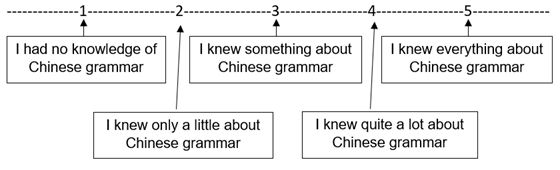
First of all, I would like you to consider this question – how much knowledge of Chinese grammar did you have as a child before you started school? You have five options to choose from:

It is quite a difficult question to answer, so I will try to help answer it at the end of the post.

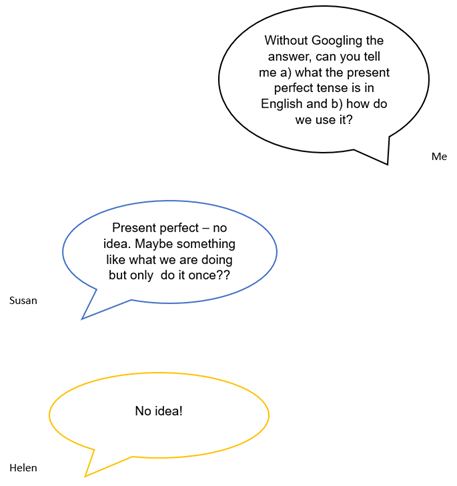
Secondly, I want you to think about this WhatsApp conversation I had with my two sisters a while ago. Both my sisters are educated native English speakers and I asked them the following question about English grammar:

As you can see from the answers above, neither of my sisters have any idea what the present perfect is. Nor are they able to explain what it is or how to use it. However, they both speak excellent English and can use the present perfect tense in conversation without ever making any mistakes. So how is it possible that they can use the present perfect but cannot explain what it is?

The difference is because of different types of language knowledge.

Both of my sisters have very good implicit knowledge of the present perfect tense, but they do not have very good explicit knowledge of the present perfect tense.

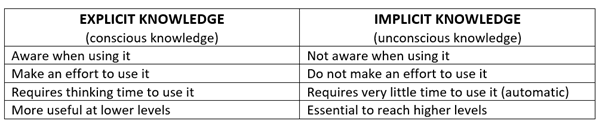
Here is a summary of these two different types of language knowledge:

Characteristics of explicit and implicit language knowledge

We use both types of language knowledge when communicating but implicit language knowledge is much more useful, especially when:

  • we do not have time to think about our language use, i.e. speaking and listening
  • we do not have any control over language use, i.e. reading and listening

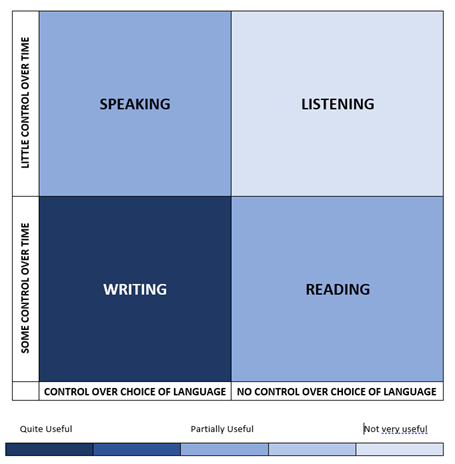
The diagrams below show my (unscientific) attempt to show how useful the different types of language knowledge can be.

Relationship between explicit language knowledge and the four skills
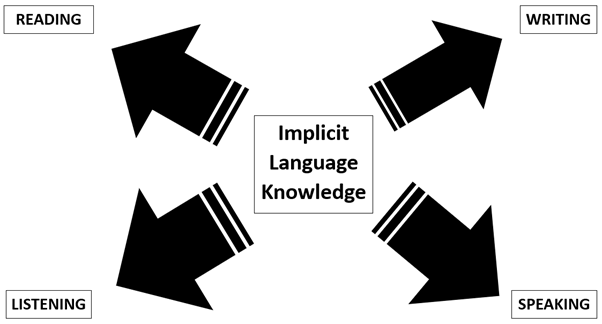
Relationship between implict language knowledge and the four skills

As you can see, the arrows in the diagram show that implicit language knowledge is more useful than explicit language knowledge for all four skills, especially listening. Explicit language knowledge is more useful for those skills when we have time to think and can control the language used, such as writing (time and control) and to a lesser extent, reading (time but no control). Explicit language knowledge can be useful at times when speaking (little time but some control) too but if you rely on it too much, then it will slow you down a lot and you will not be fluent. Explicit language knowledge is almost useless when listening as it is the only skill where you have little time and cannot control the language use. However, even though explicit language knowledge can be useful, to be successful in all skills (including reading and writing), you will need to mostly use implicit language knowledge.

Usefulness of explicit language knowledge in four language skills

In my opinion, explicit language knowledge about vocabulary is likely to be much more useful than explicit language knowledge about grammar. There are a few reasons why I think that:

  • Vocabulary has a much more significant impact on making meaning clear in communication. You are much more likely to misunderstand when reading or listening or be misunderstood when speaking or writing due to problems with vocabulary knowledge compared to problems with grammar knowledge.
  • Vocabulary is easier to remember and easier to apply in speaking and writing. A lot of grammar rules are quite complicated and abstract and so are difficult to apply when speaking or writing, whereas explicit vocabulary knowledge is easier to remember and apply.
  • Focusing on developing explicit vocabulary knowledge will have more of an effect in helping you to understand more difficult texts. Explicit grammar knowledge will not help so much in improving your reading and listening level.
  • Explicit grammar knowledge is not so useful in spoken communication. A lot of grammar in textbooks is based on written texts but the kind of grammar used in spoken communication is different to the grammar used in written communication. Therefore, the importance of ‘traditional grammar knowledge’ is less important in spoken texts. However, vocabulary knowledge is still very useful and necessary in both kinds of texts (spoken and written).

So, coming back to the original question at the beginning of the blog post about your knowledge of Chinese grammar when you started school, the answer depends on what kind of language knowledge is being referred to. As with my sisters, it is likely that you had a lot of implicit language knowledge of Chinese grammar but very little explicit language knowledge of Chinese. Today, you are likely to have much more explicit language knowledge of Chinese grammar but this knowledge is still tiny compared to the implicit language knowledge of Chinese grammar that allows you to communicate freely with very little effort. The aim in your English learning is to be able to get as close as possible to how you are able to communicate in Chinese. To do this, you should focus mainly on developing your implicit language knowledge of English. I will show you how you can do this in the next blog post.

References:

Ellis N.C. (2017) Implicit and Explicit Knowledge About Language. In: Cenoz J., Gorter D., May S. (eds) Language Awareness and Multilingualism. Encyclopedia of Language and Education (3rd ed.). Springer, Cham.

When should I take my IELTS test?

In the previous blog post, I showed how long it might take to increase your IELTS score. This is especially useful to know for students who are around the intermediate (B1) level and want to study in English at university and need an IELTS score of between 6 and 7.

However, it is obviously also useful to know what your current level is now and what kind of score you could expect to achieve if you took the IELTS test tomorrow. This information can help you to decide if you are ready to take the IELTS test. Here are the different steps that can help you decide:

1. Know what your target score is

This includes knowing both the overall score and the minimum requirement in each skill (reading, listening, writing, speaking). If you know that you are particularly weak in one skill, then this might mean you need to wait a little longer before taking the test.

2. Do at least three IELTS test practice reading and listening tests using official IELTS test materials

You will probably not get exactly the same score every time you take a test, so it is better to calculate an average score over a number of tests to be sure what your current level is. I would recommend doing at least three of these tests within a short space of time. The easiest way to do this is to buy (or borrow) one of the official Cambridge practice test books, which each contain four practice tests. For example, the most recent one is ‘IELTS Academic 15 with answers’. It doesn’t need to be the most recent edition, but more recent editions (e.g. 14, 13, 12, etc.) are better than the older editions as there have been some changes in the test over the years. Alternatively, there are also a couple of practice tests available online: here and here, which can be used. Note, that I only recommend doing this for the reading and listening as you can calculate the scores for yourself whereas it is obviously much more difficult to assess yourself accurately for the speaking and writing test.

3. Calculate your scores for the practice reading and listening tests

Once you have completed the practice tests, you can mark the tests* and calculate what band you would be likely get for both the reading and listening parts of the test. You can use an online calculator, such as this one to help you calculate your scores. Make sure that you enter the reading score in correct box (either academic or general training).

* When marking the tests, words spelt wrong should be marked incorrect. Where there are brackets around a word, it does not matter if this word is included to get an answer correct, e.g.

ANSWER: (the) information centre

both ‘the information centre’ and ‘information centre’ would be marked correct. However, ‘the information’ or ‘centre’ would both be marked incorrect as they have an essential word missing.

4. Calculate your average score for the practice tests

Add your scores together and calculate your overall average for both reading and listening, e.g.

Test 1 Reading: 6.0, Test 2 Reading: 6.5, Test 3 Reading: 7.0, READING AVERAGE = 6.5

Test 1 Listening: 6.0, Test 2 Listening: 5.5, Test 3 Listening: 5.5, LISTENING AVERAGE = 5.67

OVERALL AVERAGE (for reading and listening) = 6.085 (6.5+5.67/2)

5. Compare these reading and listening scores with your target score

You can now compare these reading and listening scores with your target score. However, as mentioned before, you need to be aware that you are probably stronger in some skills than other skills. As the table below shows, Taiwanese students tend to score more highly on the reading and listening sections compared to the writing and speaking sections.

Taken from: https://www.ieltstaiwan.org/en/ielts-performance-test-takers-asia-2018/

Therefore, I would suggest that your overall average score for the reading and listening practice tests to be at least 0.5 of a band higher than the overall score that you need. Using the example above, if you need an overall score of 6.0 with at least 5.5 in each skill, then you would probably want to wait a little bit longer before doing the test as the average for reading and listening was only just above 6.0 and most Taiwanese test takers perform worse on the writing and speaking (especially the writing). It is perhaps worth noting that although a score of L:6.0, R:6.0, W:5.5, S:5.5 would be enough to get a 6.0 overall, this is a low scoring 6.0. A score of L:6.0, R:6.5, W:6.0, S:6.0 would also be a 6.0 overall, despite getting a higher score in three of the four skills. See the IELTS website to see how IELTS scores are calculated.

How long does it take to increase my IELTS score?

As with learning English, there are a variety of factors that can influence how long it takes to increase your IELTS score. However, I will attempt to use a variety of sources that should help to give an estimate.

The most useful source for this is a research article that investigated how much students improved their IELTS score after 10-12 weeks of a full-time English course (about 200-240 hours) in private language schools in Australia and New Zealand (Elder and O‘Loughlin, 2003). The research showed that students increased their score by an average of about 0.6 of a band overall after a course of 10-12 weeks. However, there were differences in how much students improved in the different sections. On average, students improved their score by almost 0.8 of a band in listening whereas it was only 0.4 for reading. There were also big differences between individual students as some students managed to increase their score by quite a lot in this period whilst some students saw very little improvement in their score.

As with language learning in general, according to the research, it seems that it is easier to make progress at the lower band scores. For students who started the course at band 6, they had a less than 50% of increasing their overall band score over the period of a 10-12 week course (Elder and O‘Loughlin, 2003). Interestingly, the study also showed that the most successful age group were those students who were aged 20-25.

Another useful piece of research investigated score gains in the writing section of the IELTS test (Green, 2005). It also showed that students are more likely to increase their score at lower levels, e.g. a student with a 5.0 is more likely to increase their score by 0.5 of a band (to 5.5) compared to a student who already has a 6.5 and is trying to increase their score to 7.0. The article also notes how previously (before 2002), IELTS partners (Cambridge English Language Assessment, the British Council and IDP: IELTS Australia) used to provide the following statement about score gains:

‘It has been shown that individuals can take up to 200 hours to improve by one IELTS band’

(IELTS, 2002, p22 cited in Green, 2005). However, Green advised that this advice could not be supported by evidence and IELTS no longer provide such information about how long it may take a candidate to improve their IELTS score.

It is also quite useful to look at some different universities and how long they estimate that it takes to go up an IELTS band. Most universities in the UK offer pre-sessional English courses to students as an alternative to achieving the IELTS band score that they need for their chosen course. Most universities (especially those with a stronger reputation) suggest that for each 0.5 of a band that students are below their target score for their course, they would need 10 weeks of full-time study (about 200 hours) to get to the required level.

For example, imagine you wanted to study at the University of Liverpool on a course that required 6.5 overall.  If you currently have an IELTS score of:

  • 4.5, you would need to study on a pre-sessional course for 40 weeks
  • 5.0, you would need to study on a pre-sessional course for 30 weeks
  • 5.5, you would need to study on a pre-sessional course for 20 weeks
  • 6.0, you would need to study on a pre-sessional course for 10 weeks

It is similar for many other UK universities – see entry requirements for Leeds, Manchester, Sheffield, Birmingham and Nottingham.

Obviously, as with the research outlined above from Australia and New Zealand, students taking an intensive pre-sessional course will be in an English-speaking country and so would get the benefit of being surrounded by English much of the time. The only drawback of such courses is that there is relatively little time for self-study for each hour of class time (students would normally have around four to five hours of classes per day from Monday to Friday). However, if you are learning for 6 hours a week, then there is more opportunity for self-study between lessons and so slightly fewer class hours might be needed than in the examples above (but more self-study).

What is interesting is the difference between how long is suggested it might take to improve an IELTS score above compared to how long Cambridge Assessment and Cambridge University Press suggest it might take to move up one band on the CEFR, e.g. A2 to B1, B2 to C1, etc. It seems that these predictions are a lot more optimistic than for how long it takes to improve an IELTS score. One reason might be that the IELTS test is not just an assessment of general English level but an assessment of how well a candidate can communicate in an academic context. This is likely to mean extra preparation involved (e.g. learning how to do the writing part 1 and part 2 task) as well as learning more specific language that is common in academic contexts.

However, I would guess that the biggest difference is to do with the first language of many students who take the IELTS test. Remember that the predictions by Cambridge Assessment (see here) were for learners in an ideal situation, e.g. learners who share the same writing script as English (e.g. French, German, Spanish, etc.) whereas most of the students who take the IELTS test and were involved in the studies mentioned were from either East Asia or the Middle East. This means that most candidates for the IELTS test are likely to have a first language (e.g. Arabic, Chinese, Japanese, etc.) that is very different to English and so would take longer to make progress in English.

Overall then, it seems that a figure of about 200 hours of lessons is probably the best guess of how long is needed to increase by 0.5 of a band on the IELTS test on average for students who have Chinese as their first language. Obviously, it is possible to do it in less, but this depends on many factors (see here, here and here), and especially on how much effective self-study you are able to do.

References:

Elder, C., & O’Loughlin, K. (2003). Investigating the relationship between intensive English language study and band score gain on IELTS. International English Language Testing System (IELTS) Research Reports 2003: Volume 4, 207.

Green, A. (2005). EAP study recommendations and score gains on the IELTS Academic Writing test. Assessing Writing, 10(1), 44-60.

How long does it take to learn another language? (Part 4)

Conclusion (with some numbers!)

As can be seen from the previous posts, there is no easy answer to this question, but we can make some general predictions using information from this paper from Cambridge University Press (CUP) called ‘How long does it take to learn a foreign language?’ and information from Cambridge Assessment.*

First of all, it is important to be aware of how hours are counted. Both the paper from CUP and the information from Cambridge Assessment use the term ‘Guided Learning Hours’, which means hours of class time and hours spent doing guided self-study (i.e. homework set by the teacher). It does not include time spent by the learner doing self-study that a teacher has not set for homework. Obviously, it also depends how this time is spent. In my opinion, time spent doing grammar exercises is probably not as useful as communicating in English with the help of a teacher.

One interesting thing to notice is that it is generally accepted that it is easier to make more progress at lower levels than at higher levels. Below is a table taken from the paper from CUP, which shows that for adult learners with high levels of motivation and share the same L1 script as English (e.g. French, Spanish, German, etc.), approximately 90-100 hours are required to move from A1 to A2 whilst around 300-400 are needed to move from C1 to C2. These hours are likely to be higher for Taiwanese students though as obviously English and Chinese have different writing systems. However, remember that at higher levels, the first language has a much smaller impact than at lower levels.

Table taken from: https://www.cambridge.org/elt/blog/wp-content/uploads/2018/10/How-long-does-it-take-to-learn-a-foreign-language.pdf

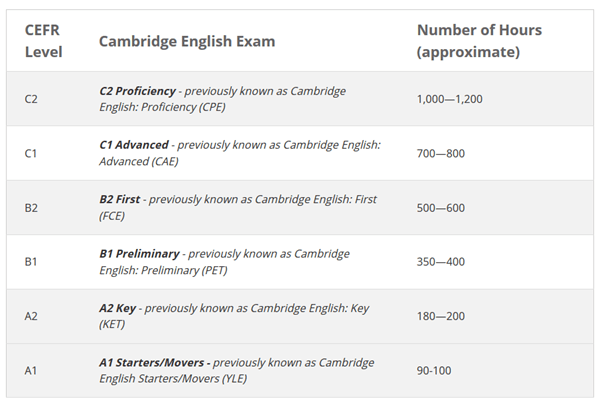
It is also interesting to see that Cambridge Assessment makes slightly different predictions to Cambridge University Press (though Cambridge Assessment does not include a learning context).

Here is the table from Cambridge Assessment:

Taken from: https://support.cambridgeenglish.org/hc/en-gb/articles/202838506-Guided-learning-hours

In summary, it is difficult to give a precise figure, but for levels between A2 and C1, an average figure of about 200 hours to move up one level (e.g. B1 to B2) seems to be the most optimistic prediction.

How long does it take to learn another language? (Part 3)

Factor 3: The Individual Learner

  • INDIVIDUAL DIFFERENCES – Differences in age, gender, personality, learning ability, motivation, etc. can all affect how quickly you learn. For example, younger learners seem to be better at learning pronunciation features of English compared to older learners. However, older learners are better at using skills and strategies to help them learn English compared to children. Motivation and personality are also factors that are likely to affect how quickly you learn, e.g. highly-motivated individuals who look for opportunities to communicate with other people in English are likely to learn faster.
  • BELIEFS ABOUT LANGUAGE AND LANGUAGE LEARNING – Learners who hold negative beliefs about their ability to communicate successfully in another language are likely to be slower in learning a language. Similarly, if the learner has negative feelings about the culture where English is spoken, this could also have a negative impact on how quickly a language can be learnt.
  • CLEAR LEARNING OBJECTIVES – Learners with clear goals and of their reasons for learning a language are likely to learn more quickly than those without clear goals and objectives. For example, learners studying for an exam such as the IELTS or TOEFL are likely to have a clearer goal and so may learn more quickly as a result.
  • FIRST LANGUAGE – The differences between English and the first language of a learner are likely to have quite a big impact. For examples, similarities in vocabulary can help many speakers of other European languages to learn English faster. On the other hand, learners whose first language is written in a different script to English (e.g. Japanese, Chinese, Korea, Arabic, Thai, etc.) are likely to learn English more slowly. As an example, the Foreign Service Institute (an American government department) put different languages into categories to show how easy or difficult they are to learn for native speakers of English. European languages such as Spanish, French and Italian are in the easiest group whereas Asian languages such as Chinese, Japanese, Korean and Arabic are in the most difficult group. Therefore, a native English speaker who is learning Spanish can make much more progress than if they are learning Chinese. The same is likely to be true in reverse, i.e. A native Chinese speaker will make more progress at learning Japanese than they would at learning English. However, there is some evidence that these differences are much more important at lower levels than at higher levels, so it’s not all bad news if you are learning English – you just need to be more patient when you are at a lower level!

Information taken from: https://www.cambridge.org/elt/blog/wp-content/uploads/2018/10/How-long-does-it-take-to-learn-a-foreign-language.pdf

How long does it take to learn another language? (Part 2)

Factor 2: The Learning Environment

The learning environment is another important factor that will influence how quickly another language can be learnt. Learning environment includes:

  • LEARNING CONTEXT – Being in an environment where you have more opportunities outside of class to communicate in English are likely to help you learn faster, e.g. by studying in a country where English is widely spoken.
  • TEACHING METHODOLOGY – There are many things that a teacher does (if you have one) that could impact on how quickly you learn. For example, what kind of activities and tasks your teacher uses in class to help you develop in all four skills. How the teacher creates a positive atmosphere for learning and the ability to give appropriate feedback are also examples of factors that are likely to affect how quickly you learn.
  • INTENSITY OF PROGRAMME – Language courses with only a few hours of study per week with little self-study provide fewer opportunities for reviewing skills and language. Therefore, these courses are likely to be less effective in helping learners to remember the skills and language learnt in class. On the other hand, more intensive courses allow quicker review of these skills and language, so learners are more likely to remember what they have learnt in lessons.
  • GROUP DYNAMICS – If you are learning in a class, then the relationships and interactions within the class are likely to be important. Classmates can give useful feedback, provide assistance and advice as well as motivation and more opportunities for interaction (both in and outside of class).
  • ACCESS TO RESOURCES – Learners who have access to a range of appropriate resources and learning materials are also likely to learn more quickly. Those resources that provide extra opportunities for input (reading and listening) at an appropriate level outside of class are likely to be especially useful.

Information taken from: https://www.cambridge.org/elt/blog/wp-content/uploads/2018/10/How-long-does-it-take-to-learn-a-foreign-language.pdf