Category: Language Learning

  • What is the Intermediate Plateau? (And how to overcome it)

    Many of you will be familiar with the word ‘plateau’ as a word that you can use to help you describe line graphs in part 1 of the IELTS writing exam. Here, according to the Longman Dictionary, plateau can be described as ‘a period during which the level of something does not change, especially after a period when it was increasing’. So, you might be able to guess that the ‘intermediate plateau’ refers to a period of time when a learner seems to make little progress and finds it difficult to reach an advanced level of English. In this blog post, I will try go give some reasons for the intermediate plateau and also suggest some solutions about how to overcome it.

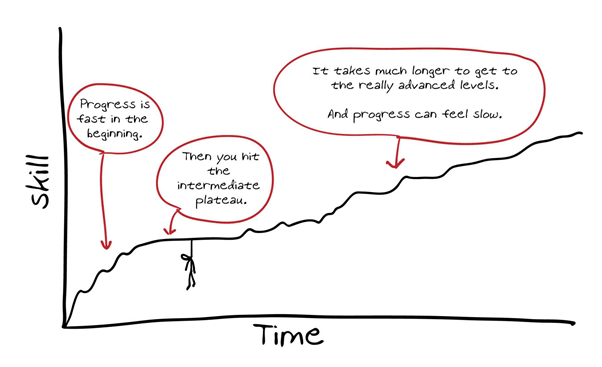
    First of all, the main reason for the intermediate plateau is that a comparison is being made with the lower levels of language learning. As a beginner with close to zero ability (in anything), it is usually quite easy to make progress fairly quickly and to also notice this progress, which brings a sense of achievement. This is because when you start out with no (or close to no) ability in something, it is almost impossible to not feel a sense of progress. After all, you cannot get worse if your ability started out at zero! However, once you get to intermediate level, you already have a level of ability and so your point of comparison is much higher, making it more difficult to notice any improvements in ability.

    Taken from: https://www.betteratenglish.com/break-intermediate-english-plateau

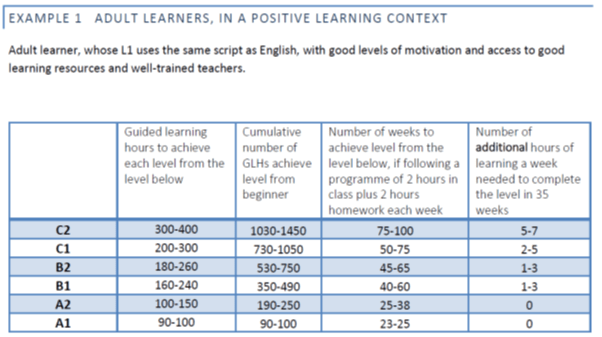
    Secondly, when you start out as a beginner, the words you learn are usually some of the most common words in a language and you will see these words over and over again (because they are the most common!). This means that you do not need to read or listen as much to get the repetitions you need to help these words to be stored in your long-term memory. Therefore, you need fewer hours of input (reading and listening) to help you progress to the next level. This is reflected in the research, as if you remember my final blog post about how long it takes to learn another language, it is suggested that it takes fewer hours to progress to the next level at lower levels of learning:

    Table taken from: https://www.cambridge.org/elt/blog/wp-content/uploads/2018/10/How-long-does-it-take-to-learn-a-foreign-language.pdf

    Another possible reason might be to do with motivation. When we start out learning something new, motivation is usually quite high at the beginning. However, over time it is quite natural that these levels of motivation begin to drop (often they are at a level that is unsustainably high to begin with) and so, with lower levels of motivation, it is normal that less time is spent on learning and it therefore takes longer to get through the intermediate stage compared to the lower levels.

    It is also important to be aware that language learning does not progress as a straight line and so there will always be some ups and downs along the way, which may mean that progress is harder to see. For example, one indicator of an advanced learner is the ability to use more complex grammar and vocabulary. However, in order to be able to use more complex language in speaking and writing, learners need to try to use this new language. Obviously, in trying this new language for the first time, mistakes are made in the process (maybe more mistakes than previously), but these mistakes are just a natural (and even necessary) stage that learners need to go through in order to progress to the next level.

    However, it is also possible that the so-called intermediate plateau doesn’t really exist at all. The reason I say that is because it might be that the type of language that learners need to get to an advanced level is more difficult to notice and measure than the type of language that is required to get from beginner level to intermediate level.

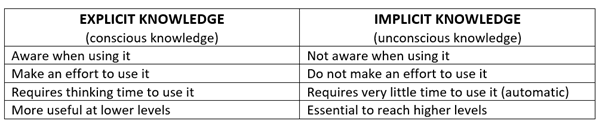
    If you remember from my previous blog post about implicit and explicit language knowledge, explicit language knowledge is much more useful at lower levels when learners don’t have any language knowledge at all. However, implicit language knowledge is essential to get to higher levels such as advanced level. Therefore, it might be that learners at intermediate level are having trouble changing their focus from developing explicit language knowledge to developing implicit language knowledge. If learners at intermediate level continue to focus too much on developing explicit language knowledge, then they are likely to be disappointed and feel frustrated at their lack of progress.

    Also, as explicit language is easier to notice and measure, there is more of a sense of achievement in developing explicit language knowledge. However, when learners are developing implicit language knowledge by reading and listening, for example, it is much more difficult to feel the benefit and the improvement in developing implicit language knowledge. This may be one reason why many learners spend too much time focusing on explicit language knowledge as it feels more like learning than developing implicit language knowledge. However, we must remember that learning a language is not like learning other subjects or skills and so we should be prepared to learn it in a different way.

    On to solutions then, which some of you may already be able to guess. If you are an intermediate level student who is preparing for the IELTS exam, one of the best things you can do is be patient. Do not set yourself unrealistic goals of when you might be able to achieve a score of say 6.5, for example. Accept that it is going to take time to reach your goal and don’t panic. Some students try to rush the process of language learning because they have a specific target in mind to achieve by a specific time. Under these circumstances, it is quite common for students to try and study really, really hard, i.e. do lots of grammar exercises, learn lots of new (and mostly useless) words and do lots of practice tests. However, doing these activities are unlikely to help that much in developing implicit language knowledge, which you need to reach the higher bands of IELTS. Instead, focus instead on doing lots of extensive reading and listening, which might not feel like ‘learning’, but will actually lead to much greater benefits in developing your language skills in the long term.

  • How to develop implicit language knowledge – Focusing on input

    In the previous blog post, I attempted to explain the difference between implicit and explicit language knowledge. I also tried to show why it is much more important for language learners to focus on developing implicit language knowledge rather than explicit language knowledge. Therefore, in this blog post, I am going to try and show you how you can develop your implicit language knowledge.

    When using English to develop implicit language knowledge, it is important to make sure that you are doing activities that involve ‘real’ communication, or what is often called ‘communicative’ activities. This means that you are not just trying to ‘study’ the language by doing grammar or vocabulary exercises, but actually doing something where the focus is on the meaning. For example, this could include:

    • Talking to a friend in English about everyday topics, e.g. complaining about the weather, asking for advice about restaurants in your area, etc.
    • Watching a film or TV series on Netflix/YouTube, etc. for your own enjoyment
    • Reading a textbook, journal article, website, etc. to gain some knowledge about a specific subject, e.g. for your work or studies.

    These are just a few examples of the many different ways in which you might use English for a real-world purpose that makes these activities ‘communicative’. Basically, almost anything that you might normally do in Chinese that you then do in English instead would count as a communicative activity. However, you probably wouldn’t read or listen to a text in Chinese and then try to learn some grammar or vocabulary from the text, unless perhaps you happen to be studying Chinese language at university. You also probably wouldn’t do exercises in Chinese to help you learn Chinese grammar or vocabulary and then do an activity to practise using this grammar or vocabulary. Doing the same kinds of activities in English, where the focus is on using a specific piece of grammar or vocabulary rather than on the message you are trying to communicate, also wouldn’t really be a communicative activity. This is because the purpose of these types of activities would be to focus on the language rather than the message, but ‘communicative’ activities have a focus on the message, not the language.

    When taking part in these kinds of ‘communicative’ activities that I have described above, you are interacting with input (reading and listening). Meaningful interaction (having a real-world purpose to communicate) with input is essential to help develop your implicit language knowledge. The reason for this is that meaningful interaction with input can help us to process language. When we process language, our brains are making a connection between the form (language, e.g. grammar and vocabulary) and the meaning of the message that is being communicated. If we are doing grammar exercises, for example, there is unlikely to be any meaningful message being communicated because the focus is on the language and so we are much less likely to process the language. When our brains process language, this helps to subconsciously (without awareness) build up our implicit language knowledge.

    So, you can see from what I have written above that getting lots of input is really important to help us develop implicit language knowledge. However, it’s not only the quantity of input that is important but also the quality of that input. In the next blog post, I will share some advice about how to ensure that you can get better quality input.

  • Why doing grammar exercises is (mostly) a waste of time – Explicit vs implicit language knowledge

    Many people know that doing lots of grammar exercises from a textbook is not very useful to help you become fluent in English. However, it can sometimes be difficult to explain why doing grammar exercises is not very useful. After all, we need grammar knowledge to help us communicate in English, so why is doing grammar exercises and learning grammar rules not very helpful?

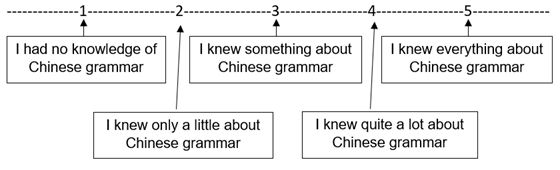
    First of all, I would like you to consider this question – how much knowledge of Chinese grammar did you have as a child before you started school? You have five options to choose from:

    It is quite a difficult question to answer, so I will try to help answer it at the end of the post.

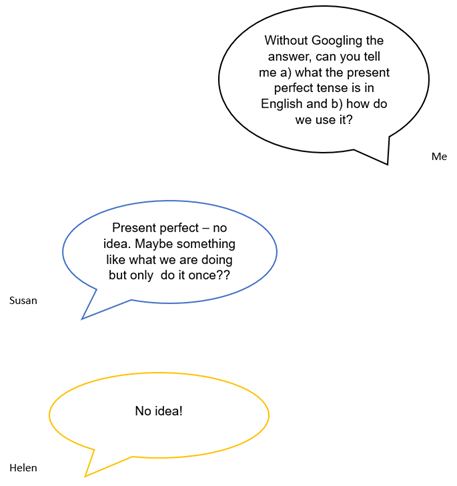
    Secondly, I want you to think about this WhatsApp conversation I had with my two sisters a while ago. Both my sisters are educated native English speakers and I asked them the following question about English grammar:

    As you can see from the answers above, neither of my sisters have any idea what the present perfect is. Nor are they able to explain what it is or how to use it. However, they both speak excellent English and can use the present perfect tense in conversation without ever making any mistakes. So how is it possible that they can use the present perfect but cannot explain what it is?

    The difference is because of different types of language knowledge.

    Both of my sisters have very good implicit knowledge of the present perfect tense, but they do not have very good explicit knowledge of the present perfect tense.

    Here is a summary of these two different types of language knowledge:

    Characteristics of explicit and implicit language knowledge

    We use both types of language knowledge when communicating but implicit language knowledge is much more useful, especially when:

    • we do not have time to think about our language use, i.e. speaking and listening
    • we do not have any control over language use, i.e. reading and listening

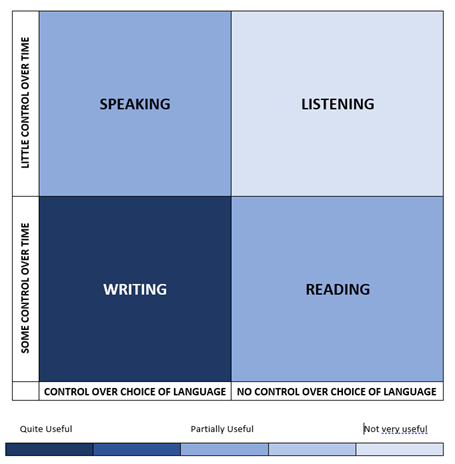
    The diagrams below show my (unscientific) attempt to show how useful the different types of language knowledge can be.

    Relationship between explicit language knowledge and the four skills
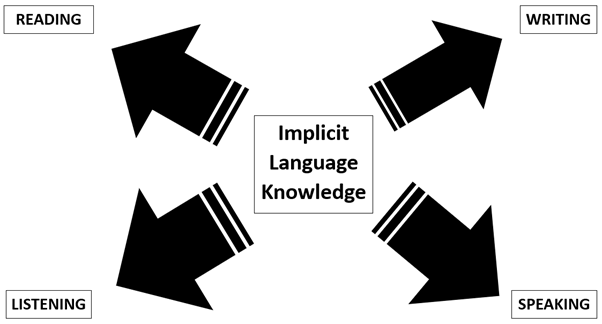
    Relationship between implict language knowledge and the four skills

    As you can see, the arrows in the diagram show that implicit language knowledge is more useful than explicit language knowledge for all four skills, especially listening. Explicit language knowledge is more useful for those skills when we have time to think and can control the language used, such as writing (time and control) and to a lesser extent, reading (time but no control). Explicit language knowledge can be useful at times when speaking (little time but some control) too but if you rely on it too much, then it will slow you down a lot and you will not be fluent. Explicit language knowledge is almost useless when listening as it is the only skill where you have little time and cannot control the language use. However, even though explicit language knowledge can be useful, to be successful in all skills (including reading and writing), you will need to mostly use implicit language knowledge.

    Usefulness of explicit language knowledge in four language skills

    In my opinion, explicit language knowledge about vocabulary is likely to be much more useful than explicit language knowledge about grammar. There are a few reasons why I think that:

    • Vocabulary has a much more significant impact on making meaning clear in communication. You are much more likely to misunderstand when reading or listening or be misunderstood when speaking or writing due to problems with vocabulary knowledge compared to problems with grammar knowledge.
    • Vocabulary is easier to remember and easier to apply in speaking and writing. A lot of grammar rules are quite complicated and abstract and so are difficult to apply when speaking or writing, whereas explicit vocabulary knowledge is easier to remember and apply.
    • Focusing on developing explicit vocabulary knowledge will have more of an effect in helping you to understand more difficult texts. Explicit grammar knowledge will not help so much in improving your reading and listening level.
    • Explicit grammar knowledge is not so useful in spoken communication. A lot of grammar in textbooks is based on written texts but the kind of grammar used in spoken communication is different to the grammar used in written communication. Therefore, the importance of ‘traditional grammar knowledge’ is less important in spoken texts. However, vocabulary knowledge is still very useful and necessary in both kinds of texts (spoken and written).

    So, coming back to the original question at the beginning of the blog post about your knowledge of Chinese grammar when you started school, the answer depends on what kind of language knowledge is being referred to. As with my sisters, it is likely that you had a lot of implicit language knowledge of Chinese grammar but very little explicit language knowledge of Chinese. Today, you are likely to have much more explicit language knowledge of Chinese grammar but this knowledge is still tiny compared to the implicit language knowledge of Chinese grammar that allows you to communicate freely with very little effort. The aim in your English learning is to be able to get as close as possible to how you are able to communicate in Chinese. To do this, you should focus mainly on developing your implicit language knowledge of English. I will show you how you can do this in the next blog post.

    References:

    Ellis N.C. (2017) Implicit and Explicit Knowledge About Language. In: Cenoz J., Gorter D., May S. (eds) Language Awareness and Multilingualism. Encyclopedia of Language and Education (3rd ed.). Springer, Cham.

  • How long does it take to learn another language?

    This is a very difficult question with no simple answer. The time it takes to learn a language can depend on many different things. Here are three important factors that can influence the answer:

    Factor 1: How ‘learning’ is defined

    There are different ways of measuring someone’s ability to learn another language. For example, do you want to measure knowledge of language, such as grammar and vocabulary or ability in the four different skills of reading, writing, speaking and listening, or maybe both at the same time?

    When it comes to language knowledge, it also depends on whether you are measuring implicit or explicit language (more about that in a later blog post). Of course, there are also good ways and not so good ways of testing language knowledge and the different language skills, so it’s quite complicated.

    One of the most common ways to measure language ability is by using the Common European Framework of Reference (CEFR). The CEFR uses ‘Can Do’ statements to measure what language learners can do in the four different skills (reading, writing, speaking and listening). For instance, at A2 a learner can ‘use simple techniques to start, maintain or end a conversation’, and at C1 a learner can ‘select a suitable phrase to preface their remarks appropriately in order to get the floor, or to gain time and keep the floor whilst thinking’.

    There are six levels in the CEFR:

    • A1 (Beginner) – Can communicate in basic English with the help of the listener
    • A2 (Elementary/Pre-Intermediate) – Can communicate in English within a limited range of contexts
    • B1 (Intermediate) – Can communicate essential points and ideas in familiar contexts
    • B2 (Upper-Intermediate) – Can use English effectively, with some fluency, in a range of contexts
    • C1 (Advanced) – Able to use English fluently and flexibly in a wide range of contexts
    • C2 (Proficiency) – Highly proficient – can use English very fluently, precisely and sensitively in most contexts

    Information taken from: https://www.englishprofile.org/images/pdf/GuideToCEFR.pdf

    The CEFR is intended to be used as a general guide that can be used in a wide variety of situations. However, if your aim is to learn English to use in a specific situation, such as for studying or for work, then it is likely that it would take a little longer to learn in order to become familiar with the specific language features that are needed in your place of study or work.

    Factor 2: The Learning Environment

    The learning environment is another important factor that will influence how quickly another language can be learnt. Learning environment includes:

    • LEARNING CONTEXT – Being in an environment where you have more opportunities outside of class to communicate in English are likely to help you learn faster, e.g. by studying in a country where English is widely spoken.
    • TEACHING METHODOLOGY – There are many things that a teacher does (if you have one) that could impact on how quickly you learn. For example, what kind of activities and tasks your teacher uses in class to help you develop in all four skills. How the teacher creates a positive atmosphere for learning and the ability to give appropriate feedback are also examples of factors that are likely to affect how quickly you learn.
    • INTENSITY OF PROGRAMME – Language courses with only a few hours of study per week with little self-study provide fewer opportunities for reviewing skills and language. Therefore, these courses are likely to be less effective in helping learners to remember the skills and language learnt in class. On the other hand, more intensive courses allow quicker review of these skills and language, so learners are more likely to remember what they have learnt in lessons.
    • GROUP DYNAMICS – If you are learning in a class, then the relationships and interactions within the class are likely to be important. Classmates can give useful feedback, provide assistance and advice as well as motivation and more opportunities for interaction (both in and outside of class).
    • ACCESS TO RESOURCES – Learners who have access to a range of appropriate resources and learning materials are also likely to learn more quickly. Those resources that provide extra opportunities for input (reading and listening) at an appropriate level outside of class are likely to be especially useful.

    Factor 3: The Individual Learner

    • INDIVIDUAL DIFFERENCES – Differences in age, gender, personality, learning ability, motivation, etc. can all affect how quickly you learn. For example, younger learners seem to be better at learning pronunciation features of English compared to older learners. However, older learners are better at using skills and strategies to help them learn English compared to children. Motivation and personality are also factors that are likely to affect how quickly you learn, e.g. highly-motivated individuals who look for opportunities to communicate with other people in English are likely to learn faster.
    • BELIEFS ABOUT LANGUAGE AND LANGUAGE LEARNING – Learners who hold negative beliefs about their ability to communicate successfully in another language are likely to be slower in learning a language. Similarly, if the learner has negative feelings about the culture where English is spoken, this could also have a negative impact on how quickly a language can be learnt.
    • CLEAR LEARNING OBJECTIVES – Learners with clear goals and of their reasons for learning a language are likely to learn more quickly than those without clear goals and objectives. For example, learners studying for an exam such as the IELTS or TOEFL are likely to have a clearer goal and so may learn more quickly as a result.
    • FIRST LANGUAGE – The differences between English and the first language of a learner are likely to have quite a big impact. For examples, similarities in vocabulary can help many speakers of other European languages to learn English faster. On the other hand, learners whose first language is written in a different script to English (e.g. Japanese, Chinese, Korea, Arabic, Thai, etc.) are likely to learn English more slowly. As an example, the Foreign Service Institute (an American government department) put different languages into categories to show how easy or difficult they are to learn for native speakers of English. European languages such as Spanish, French and Italian are in the easiest group whereas Asian languages such as Chinese, Japanese, Korean and Arabic are in the most difficult group. Therefore, a native English speaker who is learning Spanish can make much more progress than if they are learning Chinese. The same is likely to be true in reverse, i.e. A native Chinese speaker will make more progress at learning Japanese than they would at learning English. However, there is some evidence that these differences are much more important at lower levels than at higher levels, so it’s not all bad news if you are learning English – you just need to be more patient when you are at a lower level

    Information taken from: https://www.cambridge.org/elt/blog/wp-content/uploads/2018/10/How-long-does-it-take-to-learn-a-foreign-language.pdf

    As can be seen from the above information, there is no easy answer to this question, but we can make some general predictions using information from this paper from Cambridge University Press (CUP) called ‘How long does it take to learn a foreign language?’ and information from Cambridge Assessment.*

    First of all, it is important to be aware of how hours are counted. Both the paper from CUP and the information from Cambridge Assessment use the term ‘Guided Learning Hours’, which means hours of class time and hours spent doing guided self-study (i.e. homework set by the teacher). It does not include time spent by the learner doing self-study that a teacher has not set for homework. Obviously, it also depends how this time is spent. In my opinion, time spent doing grammar exercises is probably not as useful as communicating in English with the help of a teacher.

    One interesting thing to notice is that it is generally accepted that it is easier to make more progress at lower levels than at higher levels. Below is a table taken from the paper from CUP, which shows that for adult learners with high levels of motivation and share the same L1 script as English (e.g. French, Spanish, German, etc.), approximately 90-100 hours are required to move from A1 to A2 whilst around 300-400 are needed to move from C1 to C2. These hours are likely to be higher for Taiwanese students though as obviously English and Chinese have different writing systems. However, remember that at higher levels, the first language has a much smaller impact than at lower levels.

    Table taken from: https://www.cambridge.org/elt/blog/wp-content/uploads/2018/10/How-long-does-it-take-to-learn-a-foreign-language.pdf

    It is also interesting to see that Cambridge Assessment makes slightly different predictions to Cambridge University Press (though Cambridge Assessment does not include a learning context).

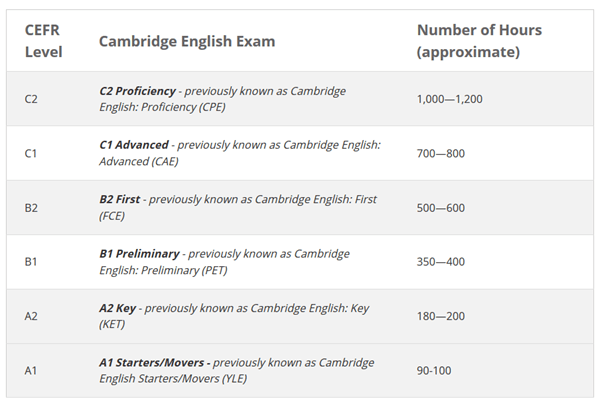
    Here is the table from Cambridge Assessment:

    Taken from: https://support.cambridgeenglish.org/hc/en-gb/articles/202838506-Guided-learning-hours

    In summary, it is difficult to give a precise figure, but for levels between A2 and C1, an average figure of about 200 hours to move up one level (e.g. B1 to B2) seems to be the most optimistic prediction.