Category: Input (Reading and Listening)

  • Extensive Reading Recommendations

    As I have shown in a previous blog post, doing extensive reading with graded readers is one of the most useful things you can do to improve your English. However, sometimes it can be difficult to know what book to choose that will be interesting. Since I mostly read non-fiction books for pleasure, I am not sure that I am very good at recommending what books to read, especially as each person will have different interests. Despite that, I have managed to produce a list of books that might be a useful starting point for learners who have difficulty in choosing what to read. By using a list of the finalists and winners (winners have a * next to their title) from the Extensive Reading Language Learner Literature Award, I have created a list of recommendations.

    Please note, that I have only included books that are available to read online from the English e-Reader website. You can access an online text of the book by clicking the name of the book title. If you want more information, you can click the name of the publisher, which will take you to their page. I am not sure about the accuracy of the information on the English e-Reader website, so the information about pages and level has been taken from the publisher, rather than the website English e-Reader website. For some classic books, there has been more than one book written by different publishers, so I am not always 100% sure which version has been used. I have indicated this with a question mark (?) next to the publisher name.

    For the final two columns of the table below, CEFR level = Common European Framework of Reference for Languages level, where B1 = intermediate, B2 = upper-intermediate and C1 = advanced. ERF level = Extensive Reading Foundation level. You can find your level by going to the Extensive Reading Central website and following the instructions after clicking ‘Check my Level’.

    https://www.er-central.com/student-registration/
    BOOK TITLE (Publisher)PUBLISHERGENRETYPEPAGES ERF LEVELaCEFR LEVELb
    The Everest StoryOxfordNon-Fiction Modern808A2/B1
    Rabbit-Proof FenceOxfordNon-FictionModern808A2/B1
    The No.1 Ladies Detective AgencyPearsonDetectiveModern569A2/B1
    The Eighth SisterBlack CatHuman InterestModern809A2/B1
    Body on the RocksHueberMysterlyModern8411B1
    Not Without YouOxfordSci-FiModern7211B1
    The Accidental TouristOxfordMysteryModern11211B1
    Captain Corelli’s MandolinPearsonRomanceModern12014B2/C1
    The Best of Times?*CambridgeRomanceModern11215C1

    a* ERF = Extensive Reading Foundation
    b* CEFR = Common European Framework of Reference for Languages

  • High quality input for advanced learners to help prepare for the IELTS exam

    In the previous blog post, I mentioned how extensive reading (especially graded readers) can be a useful source of input. One of the advantages of using graded readers is that they are available at different levels and so it is easy for people of all abilities to find a suitable book. However, if you are an advanced level learner of English, you might be ready to read and listen to texts that have not been adapted for learners. Obviously, this can be quite difficult, but it also gives you a much wider range of texts to choose from.

    For the IELTS exam, you will need to read ‘three long texts which range from the descriptive and factual to the discursive and analytical. These are taken from books, journals, magazines and newspapers.’ Obviously, the word ‘factual’ is important here, so if you want to read texts that are similar in style to the IELTS test, then you need to be careful about what kinds of texts you choose to read.

    First of all, you probably wouldn’t want to focus on reading novels as these are not factual texts. I would also advise against reading anything too political as the IELTS exam doesn’t really do politics. Also, news articles don’t seem to appear in the IELTS test as they go out-of-date very quickly. You probably want to focus more on texts that cover a range of topics but are perhaps written in a slightly more formal style for an educated audience and will still be relevant at least a year after they have been written.

    There are quite a few magazines that report studies on a range of topics for a non-specialist audience. These kinds of magazines are easier to read than academic journals and are probably quite similar in style and language to many of the texts that you might find on an IELTS exam. They are also not too long to read, so will be similar in length to the IELTS exam. Here are some links to a few different science magazines that might be interesting and useful to read:

    https://www.newscientist.com/

    https://www.scientificamerican.com/

    https://www.nationalgeographic.com/magazine/

    https://www.psychologytoday.com/intl

    https://www.sciencemag.org/

    https://www.sciencefocus.com/

    https://www.discovermagazine.com/

    https://www.the-scientist.com/

    When looking for articles to read, it would be a good idea to try and find articles that are not too specific and are of general interest to most people as these are the kinds of texts that are likely to appear in the IELTS exam.

    You can also choose appropriate sections from newspapers and online news sites to help you find suitable articles, e.g. from the BBC website, you might find some interesting articles from any of the Culture, Future, Travel or Business sections. You can also use newspapers to find interesting articles in the science sections of newspapers such as The Guardian, The New York Times and The Australian. Culture, Travel and Lifestyle sections might also have interesting and useful articles from online newspapers.

    When it comes to listening material, the BBC also has a wide range of podcasts to choose from. If you are not familiar with podcasts, you will want to download a podcast player to your phone, so that you can search for podcasts and add them to your feed. You will then be notified when a new episode is available. I use an app called Player.fm, which works well for me but there are lots of different ones available.

    The BBC has lots of different podcasts available, so one of the best places to start might be the BBC World Service, which is aimed at people around the world rather than just a British audience. One podcast that is quite interesting is called The Big Idea, which has a range of interesting topics that I could imagine appearing in the IELTS exam. It is also quite short, so you could easily listen to it in less than fifteen minutes, e.g. on the MRT or bus to work, university, etc. Unfortunately, they have stopped producing episodes, but there are still plenty of old episodes to listen to. Another short BBC podcast that is no longer produces new episode, but has a large number of older episdoes to listen to is 50 Things that Made the Modern Economy. It deals with a range of topics related to inventions, ideas and innovations, so is likely to cover many topics that would appear on the IELTS test.

    Another short podcast from the BBC that I like to listen to is called More or Less: Behind the Stats. Whilst it does talk about Coronavirus rather a lot and is a bit biased towards UK news, it obviously talks a lot about statistics too so could be quite useful to help you review describing statistics (part 1 writing).

    A few other BBC podcasts that I have listened to are: Deeply Human (about the science behind human experiences), Science in Action (about science in the news), Discovery (about science in general), Crowd Science and The Inquiry (about ideas in the news).

    Obviously, for advanced learners, there are lots of different material available that could be useful and interesting for you, so if you have any suggestions, then please feel free to post them in the comments.

  • How to get good quality input – Extensive reading

    In the last blog post, I wrote about the importance of getting lots of input in order to develop your implicit language knowledge. There is also another blog post that shows how a high level of implicit language knowledge is essential for effective communication in English.

    However, getting the right quality of input is also very important. Probably the most important aspect is making sure the input (through reading and listening) that we receive is at the right level. If we cannot understand the input that we receive, then we will not correctly process the information. Here, processing means being able to understand the meaning of the message in the input and matching it in our brains (mostly unconsciously) to the language used to create the message. However, if we cannot process the information, our implicit language knowledge will not develop. Therefore, it is very important that the language we receive in the input is at the right level.

    I find that this is one of the most common problems that many learners have when trying to learn English independently. They try to watch TV shows, films, YouTube videos or read magazines, websites, newspapers, etc. in English but quickly realise that this is often too difficult and so they don’t understand enough to find it enjoyable. The problem is that most of what these learners are trying to watch, listen to or read in English is not aimed at language learners – it is mostly aimed at people who speak English as a first language. There is rarely any attempt to make it easier for language learners to understand the texts and so it is obviously often very difficult to understand. Therefore, for most English learners, it is better to use input that is specifically aimed at language learners.

    One of the best ways to do this is through extensive reading and listening. Extensive reading is defined as “an approach to language learning that encourages students to read a large amount of books, or other reading material, that is relatively easy for them to understand. Ideally, the books should be easier than their current reading level so that they can read quickly, without having to look up words in a dictionary”. One of the best ways of doing extensive reading is by using graded readers. These are books that have been especially written or adapted for leaners of English at different levels. This means that learners can choose from books that are at a suitable level for them.

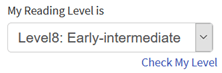
    A quick way to find out your extensive reading (or listening) level by going to the ‘Check my Level’ section of the student registration page on the ER Central website:

    When you click on ‘Check My Level’, you will see the following image:

    You should place your mouse arrows over one of the numbers and start reading. If you think you know all the words in the text, you can try a higher level. If there are three or more words that you don’t know, then you should try a lower level. The right level for you should have one or two words that you don’t know. If your level is higher than 13, then click the arrow on the right to reveal more levels (there are 20 in total). You can try reading at different levels and see which one you find you are comfortable with. If you are not sure, it’s probably better to go down a level.

    Once you know your extensive reading level, you can now look for reading material that is at the right level for you. On the same website as the level test, you can find lots of reading and listening texts that are organised by level and category (e.g. crime, romance, true story, etc.). However, most of these texts are quite short and you probably want to read something longer. Another website that you can use, which has longer texts, is the following: https://english-e-reader.net.

    Again, you can search by level to help you find a book that is at a suitable level for you.

    If you study at Intake, you can also find some books in the book case in the corner next to reception. The orange books and other books on the same shelf are fiction books and come in a range of levels. There are some non-fiction books in the coloured folders, but are probably too easy for higher level learners. If you study at university, your library might also have some graded readers that you can borrow. Alternatively, you might be able to find some in Taipei public libraries.

    If you are a higher level student and want something a bit more challenging but still simplified for language learners, you can try some of the mid-frequency graded readers available from Victoria University.

    If you are preparing for the IELTS exam, then you might also want to focus on texts that are more ‘academic’ than reading a novel. In this case, you might want to try reading some non-fiction books instead of novels as the topic and style of the writing in non-fiction will be closer to the IELTS exam compared to when reading a novel. In this blog post, I have given some suggestions for the kinds of non-fiction texts that advanced learners could read and listen to in order to help them prepare for the IELTS exam.

  • How to develop implicit language knowledge – Focusing on input

    In the previous blog post, I attempted to explain the difference between implicit and explicit language knowledge. I also tried to show why it is much more important for language learners to focus on developing implicit language knowledge rather than explicit language knowledge. Therefore, in this blog post, I am going to try and show you how you can develop your implicit language knowledge.

    When using English to develop implicit language knowledge, it is important to make sure that you are doing activities that involve ‘real’ communication, or what is often called ‘communicative’ activities. This means that you are not just trying to ‘study’ the language by doing grammar or vocabulary exercises, but actually doing something where the focus is on the meaning. For example, this could include:

    • Talking to a friend in English about everyday topics, e.g. complaining about the weather, asking for advice about restaurants in your area, etc.
    • Watching a film or TV series on Netflix/YouTube, etc. for your own enjoyment
    • Reading a textbook, journal article, website, etc. to gain some knowledge about a specific subject, e.g. for your work or studies.

    These are just a few examples of the many different ways in which you might use English for a real-world purpose that makes these activities ‘communicative’. Basically, almost anything that you might normally do in Chinese that you then do in English instead would count as a communicative activity. However, you probably wouldn’t read or listen to a text in Chinese and then try to learn some grammar or vocabulary from the text, unless perhaps you happen to be studying Chinese language at university. You also probably wouldn’t do exercises in Chinese to help you learn Chinese grammar or vocabulary and then do an activity to practise using this grammar or vocabulary. Doing the same kinds of activities in English, where the focus is on using a specific piece of grammar or vocabulary rather than on the message you are trying to communicate, also wouldn’t really be a communicative activity. This is because the purpose of these types of activities would be to focus on the language rather than the message, but ‘communicative’ activities have a focus on the message, not the language.

    When taking part in these kinds of ‘communicative’ activities that I have described above, you are interacting with input (reading and listening). Meaningful interaction (having a real-world purpose to communicate) with input is essential to help develop your implicit language knowledge. The reason for this is that meaningful interaction with input can help us to process language. When we process language, our brains are making a connection between the form (language, e.g. grammar and vocabulary) and the meaning of the message that is being communicated. If we are doing grammar exercises, for example, there is unlikely to be any meaningful message being communicated because the focus is on the language and so we are much less likely to process the language. When our brains process language, this helps to subconsciously (without awareness) build up our implicit language knowledge.

    So, you can see from what I have written above that getting lots of input is really important to help us develop implicit language knowledge. However, it’s not only the quantity of input that is important but also the quality of that input. In the next blog post, I will share some advice about how to ensure that you can get better quality input.