In previous posts, I have explained the importance of developing implicit language knowledge in order to become fluent in English at a high level. We can do this mostly by getting the right kind of input (see here, here and here). By doing lots of reading and listening we are learning vocabulary incidentally (implicitly). In other words, we are developing our implicit vocabulary knowledge by reading and listening for meaning rather than through any deliberate focus on learning vocabulary. This type of learning is obviously very important, but it can also be supported through learning vocabulary deliberately (explicitly). Here, we are developing explicit vocabulary knowledge, but doing this can also help to develop our implicit vocabulary knowledge. It does this because it: a) helps to give us more repetitions, so that we learn faster, and b) helps us to be able to read and listen to more difficult texts, therefore allowing us to get more input, which we know helps develop our implicit vocabulary knowledge.
Remember though that implicit language knowledge is really important for developing fluency in a foreign language, so it is important that deliberate vocabulary learning is used in addition to getting lots of input, and not a replacement for it. In my opinion, you should still spend considerably more time on getting input through reading and listening compared to deliberate vocabulary learning.
However, when doing deliberate vocabulary learning, it is very important that it is targeted, so that the most useful kind of vocabulary is learnt. Obviously, for students who are preparing for the IELTS test, vocabulary that is frequent in the texts for the reading and listening components will be useful as well as vocabulary that can be used in the speaking and writing components.
One way we can help to focus our vocabulary learning is by thinking about the type of vocabulary that is likely to be seen in reading and listening texts as well as be useful to use in the writing and speaking components. One way of doing this is by looking at some research (see Coxhead, 2000) into academic texts. This research showed that these texts generally had the following profile:
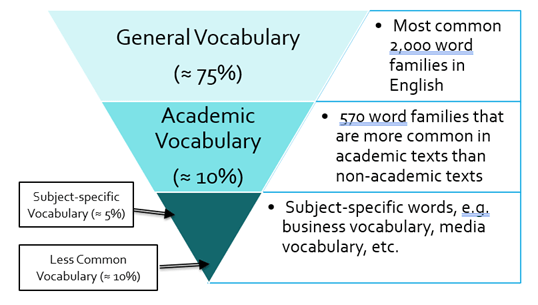
This diagram helps to show that we need to focus on the most common general words in English as these account for around three-quarters of all words in an academic text. However, these 2,000 words that are referred to above are taken from a word list that was created nearly seventy years ago (see West, 1953), so it might be a good idea to find a more up-to-date list of words to focus on.
Furthermore, most learners who are preparing for IELTS will already know most of these 2,000 words, so I am going to focus on learning ‘academic’ words in this post. The previously mentioned research (see Coxhead, 2000) analysed lots of different academic texts across lots of different academic subject areas (e.g. Medicine, Law, Economics, English Literature, Chemistry, History, etc.). This analysis was used to create a list of words that are common in all different academic subject areas. The result was the creation of the Academic Word List (AWL), which is a list of 570 word families (e.g. analyst, analyse, analysis, analytic, etc. all count as one word family). You can find a list of these word families here: https://www.eapfoundation.com/vocab/academic/awllists/
Some of these words, you will already know and some of them will be new to you. Apart from looking at the list above, there are a couple of ways that we can check whether a word appears on the Academic Word List (AWL). The first way is by checking in the Longman dictionary. When we search for a word in this dictionary, it will tell us if a word appears on the Academic Word List by indicating ‘AWL’ in a yellow box. If we can see this yellow ‘AWL’ box, this indicates that the word appears on the Academic Word List, and is therefore quite a useful word to learn, e.g. see below for ‘analyse’:
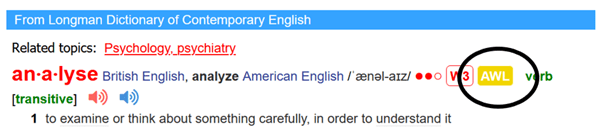
This is probably the best way to check any new words that you might see in your textbook or any texts printed on paper or in a book. However, if you are reading an online text, it can be better to use the AWL highlighter, which will highlight any words from the AWL when you copy the text into the box on the following page: https://www.eapfoundation.com/vocab/academic/highlighter/
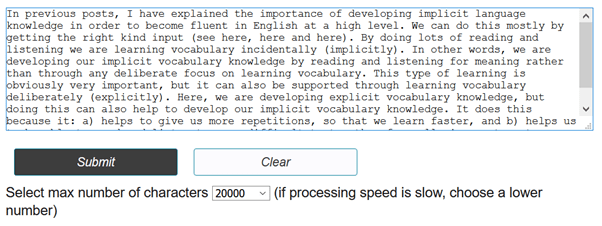
Using the first paragraph from this blog post as an example, you can see below that several words have been highlighted. You will notice that some are coloured grey and some are coloured orange:

If you look on the sidebar on the left, you can see that these colours relate to different ‘levels’. These levels (1-10) are organised by frequency. In other words, level 1 has the most frequent academic words and level 10 has the least frequent academic words.
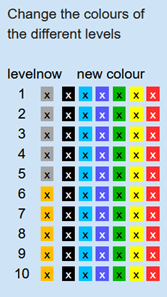
Now obviously, it would be nice to know all of these words on the Academic Word List, but there are a lot to learn, so that could be quite a big task. It is therefore better to focus your vocabulary learning on the most useful words from the list, i.e. levels 1, 2, 3, etc. rather than say levels 9 and 10. However, where you start learning on the list will depend on how many words you already know from the list (most learners will probably already know quite a lot of words from level 1).
When using this tool, you can change the colours for each level to help you identify the words from the levels that you want to focus on.
Before finishing, I should mention that the Academic Word List is not the only list of academic words, but it is probably the most well-known. If you are interested in other lists of academic words, you might want to read this journal article (Therova, 2020). One of the lists mentioned in the article is from Oxford Dictionaries called the Oxford Phrasal Academic Lexicon (OPAL), which has more words than the Academic Word List and also divides words into spoken and written academic words. It also has different sublists, thus allowing you to target your vocabulary learning.
In a later blog post, I will show you some apps that you can use to help you learn the words from the Academic Word List. However, in the next blog post, I will show some tools that help to focus your vocabulary learning on ‘general’ vocabulary.
References
Coxhead, A. (2000). A New Academic Word List. TESOL quarterly, 34(2), pp213-238.
Therova, D. (2020). Review of Academic Word Lists. TESL-EJ, 24(1). Available at: https://www.tesl-ej.org/wordpress/issues/volume24/ej93/ej93a5/
West, M. (1953). A General Service List of English Words. London: Longman, Green and Co.


Leave a comment